Categories
insights IOT Internet Of Things IoT MES IoT Preventive Maintenance

MQTT in Modern Manufacturing

The Communication Layer Behind Connected Manufacturing

How do machines actually communicate with modern manufacturing platforms?

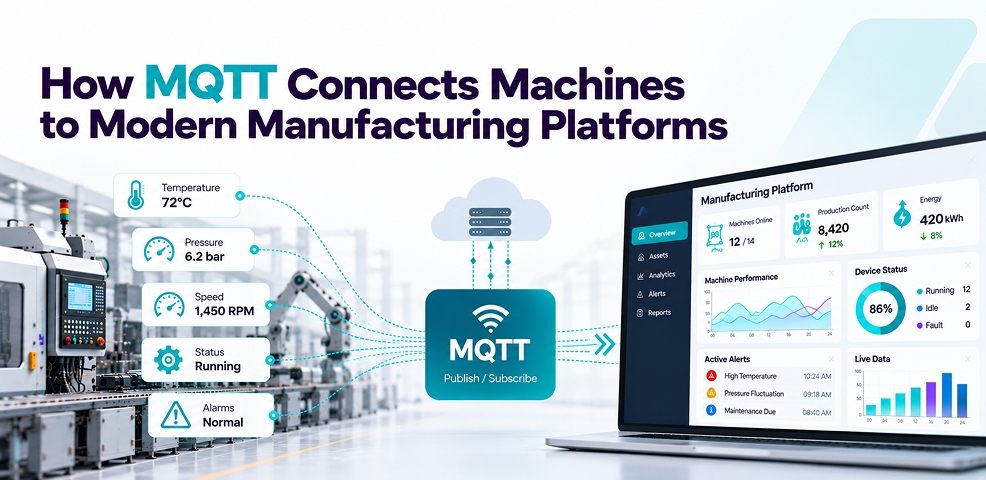
In a connected manufacturing environment, machines and industrial equipment continuously generate data. Temperature, pressure, speed, machine status, alarms, production values, and other operational parameters can provide valuable insights into what is happening on the factory floor.

But collecting this data is only the first step. The data needs a reliable and efficient way to move from machines and industrial devices to the software platforms that can monitor, analyze, and act on it.

This is where MQTT (Message Queuing Telemetry Transport) plays an important role.

What Is MQTT?

MQTT is a lightweight messaging protocol designed for efficient communication between devices and applications. It uses a publish/subscribe communication model, making it well suited for connected manufacturing environments.
Instead of machines communicating directly with every application that needs their data, MQTT uses a central
MQTT broker to manage the communication.

A simplified flow looks like this:

Machine / Sensor → MQTT Publisher → MQTT Broker → MQTT Subscriber → Manufacturing Platform

For example, a machine may publish its current temperature to a specific MQTT topic. A manufacturing platform subscribed to that topic can receive the data in real time and use it for monitoring, analytics, alerts, or other operational processes.

How MQTT Works in Manufacturing

However, connecting machines is not the final objective. The real value comes from what organizations can do with the data.
The machine or an edge device can publish information such as:

  • Machine running or stopped status
  • Temperature
  • Pressure
  • Speed
  • Production count
  • Energy consumption
  • Faults and alarms

This information is published to specific MQTT topics.

The MQTT broker receives these messages and distributes them to the applications or systems that have subscribed to the relevant topics.

For example:

Machine → factory/line1/press01/temperature → MQTT Broker → Monitoring Platform

The manufacturing platform can then process this information and present it to operators, maintenance teams, production managers, or other users.

Why MQTT Is Useful for Connected Factories

Manufacturing environments often contain different types of machines, controllers, sensors, and industrial systems. These devices may generate data continuously and at different frequencies.

MQTT provides a lightweight communication layer that can help connect these data sources to modern applications.

Some of its key characteristics include:

Lightweight Communication

MQTT has low communication overhead, making it suitable for environments where devices have limited network resources or where large volumes of machine data need to be transmitted efficiently.

Publish/Subscribe Architecture

The publish/subscribe model separates data producers from data consumers.

A machine does not need to know which application will use its data. It simply publishes the data, while authorized applications subscribe to the topics they need.

Real-Time Data Flow

Manufacturing platforms can receive machine information as it is published, enabling near real-time visibility into production and equipment conditions.

Scalable Connectivity

As factories add more machines, sensors, and connected devices, MQTT can provide a structured communication layer for handling data from multiple sources.

From Machine Data to Manufacturing Intelligence

Connecting machines is not the final objective.

The real value comes from what organizations can do with the data after it has been collected.

Once machine data reaches a manufacturing platform, it can support applications such as:

  • Real-time machine monitoring
  • Production visibility
  • Equipment status tracking
  • Alarm and event monitoring
  • Performance analysis
  • Predictive maintenance
  • OEE monitoring
  • Production analytics
  • Operational decision-making

For example, a machine’s temperature data by itself may not provide much value. But when that data is continuously collected, visualized, analyzed against historical trends, and combined with machine status or production information, it can help teams identify abnormal conditions and respond earlier.

MQTT and Modern Manufacturing Platforms

Modern manufacturing platforms act as a bridge between industrial equipment and the people responsible for production and operations.

Platforms such as IOT3Sixty from Aagnia Technologies can use industrial data to provide greater visibility into connected assets and operations.

The communication layer helps bring machine data into the platform, while the platform turns that data into meaningful information that teams can monitor and use.

This creates a connected flow:

Machines → Data → Communication → Platform → Insights → Action

The goal is not simply to connect more machines. The goal is to make the information generated by those machines useful for the people managing manufacturing operations.


The Bigger Picture

MQTT is one piece of the larger industrial connectivity ecosystem. Depending on the machine, controller, application, and architecture, manufacturing environments may also use technologies such as OPC UA, Modbus, REST APIs, or other industrial communication methods.

The right approach depends on the existing equipment, connectivity requirements, system architecture, and business objectives.

What matters is creating a reliable path from the factory floor to the systems that can turn operational data into actionable insights.

Conclusion:

MQTT provides a lightweight and flexible communication layer for connecting machines, sensors, and industrial devices with modern manufacturing platforms.

By enabling machine data to move efficiently from the factory floor to connected applications, MQTT can support real-time monitoring, analytics, alerts, and better operational visibility.

But the real value isn’t simply connecting machines.

It is turning machine data into information that teams can actually use to understand operations, identify problems, and make better decisions.

What communication protocol is your manufacturing setup using today — MQTT, OPC UA, Modbus, or something else?
Categories
IoT Preventive Maintenance

How Smart Batch Operations Improve Production Traceability

How Smart Batch Operations Improve Production Traceability

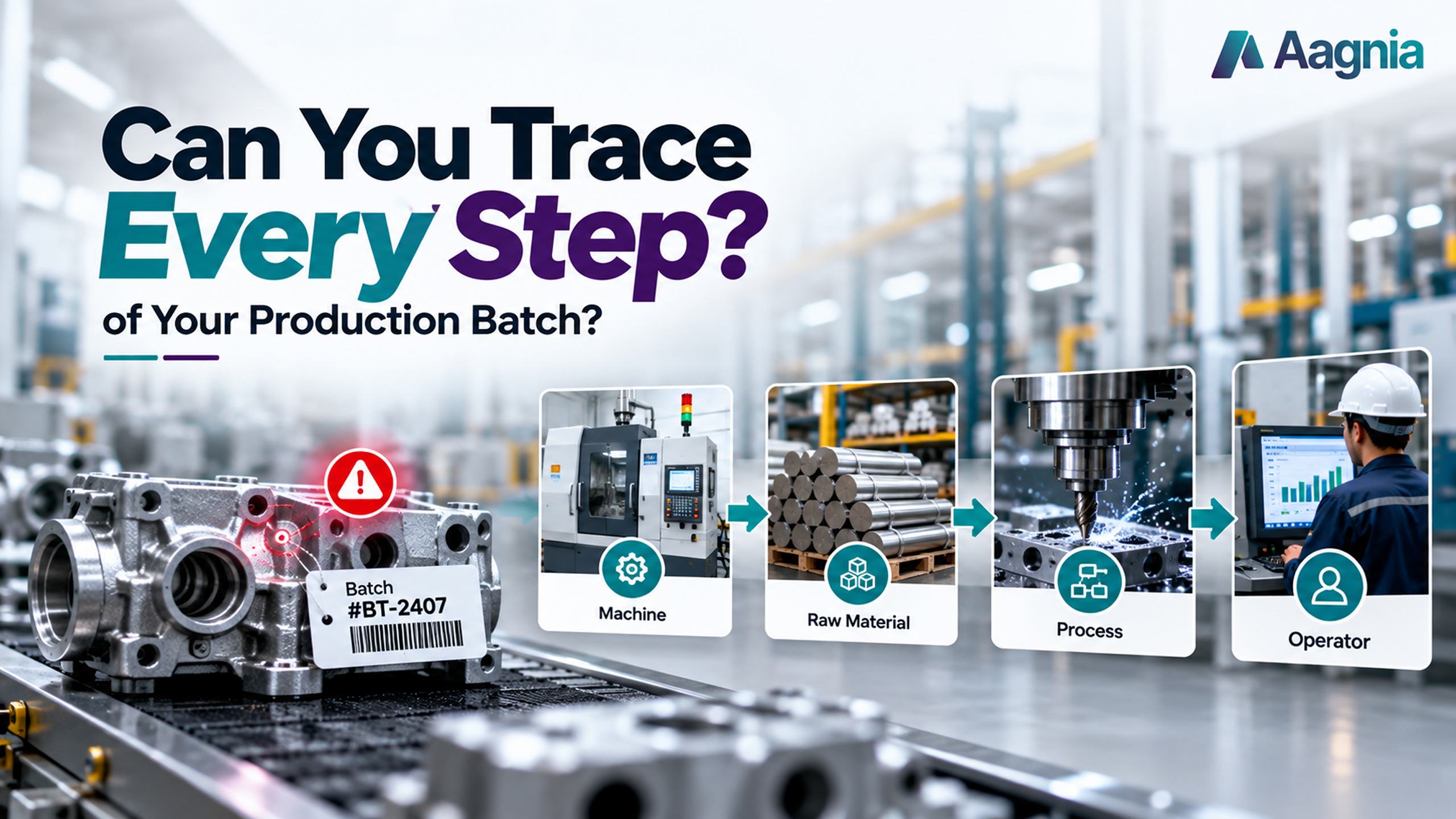
One production batch. One quality issue. Can you trace exactly what happened?

Imagine a customer reports a quality issue with a product delivered last week. The first questions are simple, but finding the answers can be difficult:

Which batch was involved? Which raw materials were used? Which machine produced it? Which process was followed? Which operator handled the production?

Without connected and organized production data, tracing this information can take hours or even days.

This is where batch operations and production traceability become important.

What Is Production Traceability?

Production traceability is the ability to track and record the history of a product throughout its manufacturing journey.

Depending on the manufacturing process, traceability can connect information such as:

  • Raw materials and material batches
  • Production orders
  • Batch numbers
  • Machines and equipment
  • Production processes
  • Operators and shifts
  • Production quantities
  • Quality results
  • Process parameters
  • Downtime and production events
  • Finished goods

By connecting these details, manufacturers can build a clearer record of what was produced, when it was produced, what materials were used, and how the production process was carried out.

Why Is Batch Traceability Important?

Manufacturing processes involve multiple stages, materials, machines, and production activities. If these activities are recorded separately, it can become difficult to establish the relationship between them.

For example, a finished product may be linked to a particular production batch, but identifying the exact raw material batch, machine, process conditions, and quality results associated with that production may require checking multiple records.

A connected batch traceability system can make these relationships easier to follow.

This can help manufacturers with:

  • Faster quality investigations
  • Better production visibility
  • More accurate batch records
  • Easier identification of affected products
  • Improved root-cause analysis
  • Reduced time spent searching for production information
  • Better compliance and documentation


How Smart Batch Operations Improve Traceability

1. Batch-Wise Production Tracking

Every production batch can be assigned a unique identity and tracked throughout the manufacturing process.

Important information can be associated with the batch, including:

  • Production order
  • Product or item
  • Planned quantity
  • Actual quantity
  • Production date and time
  • Production line
  • Machine
  • Shift
  • Operator

This creates a structured production history for each batch.

2. Material-to-Production Traceability

Raw materials are an important part of production traceability.

A finished batch may contain materials received from different suppliers or material lots. Recording which material batches were consumed during production helps establish a relationship between the input materials and the finished product.

This makes it easier to answer questions such as:

Which raw material batches were used to produce this finished batch?

Similarly, manufacturers can investigate which finished batches were produced using a particular raw material lot.

3. Machine and Process Visibility

Production traceability becomes more useful when batch information is connected with machine and process data.

Manufacturers can track information such as:

  • Machine used
  • Process stage
  • Production parameters
  • Cycle time
  • Machine status
  • Process events
  • Downtime
  • Production quantities

This helps provide greater context around how a particular batch was produced.

If a quality issue is identified, teams can investigate whether the affected batch was associated with a particular machine, process, or production condition.

4. Real-Time Production Information

Traditional production records may be updated after production activities have already taken place.

Real-time production monitoring can provide information while manufacturing is in progress.

Teams can monitor:

  • Current batch status
  • Production progress
  • Machine status
  • Production quantities
  • Process events
  • Quality information
  • Downtime

This can help production teams identify issues earlier rather than discovering them only after the batch has been completed.

5. Faster Root-Cause Investigation

When a quality issue occurs, the investigation often involves reviewing multiple records.

A connected traceability system can bring relevant batch, material, machine, process, and quality information together.

For example, if a finished product fails a quality inspection, the investigation can begin by identifying:

Finished Product → Batch → Production Order → Materials → Machine → Process → Quality Results

This creates a structured path for investigating where the issue may have originated.


From Production Records to Connected Traceability

Simply collecting production records is not enough.

The real value comes from connecting information across different stages of the manufacturing process.

A connected traceability structure can follow:

Material → Batch → Production Order → Machine → Process → Quality → Finished Product

When these relationships are maintained consistently, manufacturers can build a more complete production history.

This can also reduce dependence on manually searching through spreadsheets, paper records, or disconnected systems.

Traceability and Quality Management

Quality management and production traceability are closely connected.

When quality problems occur, manufacturers need reliable production information to understand the scope and possible source of the issue.

Traceability can help teams identify:

  • Affected production batches
  • Related material lots
  • Machines involved
  • Production periods
  • Quality inspection results
  • Related finished products

This information can support faster investigation and more informed corrective action.

The Role of Digital Batch Operations

Digital batch operations can bring together production planning, material consumption, machine information, process data, and quality information within a connected production environment.

Instead of treating each production record as an isolated entry, manufacturers can create relationships between the different events that occur during production.

This makes it easier to move from simply asking:

“What was produced?”

to asking:

“What materials, machines, processes, and conditions were involved in producing it?”

Conclusion:

Production traceability is about more than assigning a batch number.

It is about creating a connected history of the manufacturing process—from raw materials and production orders to machines, processes, quality results, and finished products.

With smart batch operations and connected production data, manufacturers can improve visibility, simplify quality investigations, support root-cause analysis, and respond more effectively when production issues occur.

The goal is simple:

Know the batch. Know the material. Know the machine. Know the process. Know what happened.

Better traceability leads to better visibility, faster investigation, and more informed manufacturing decisions.

Categories
IoT Preventive Maintenance

Predictive Maintenance: How IoT and AI Work Together

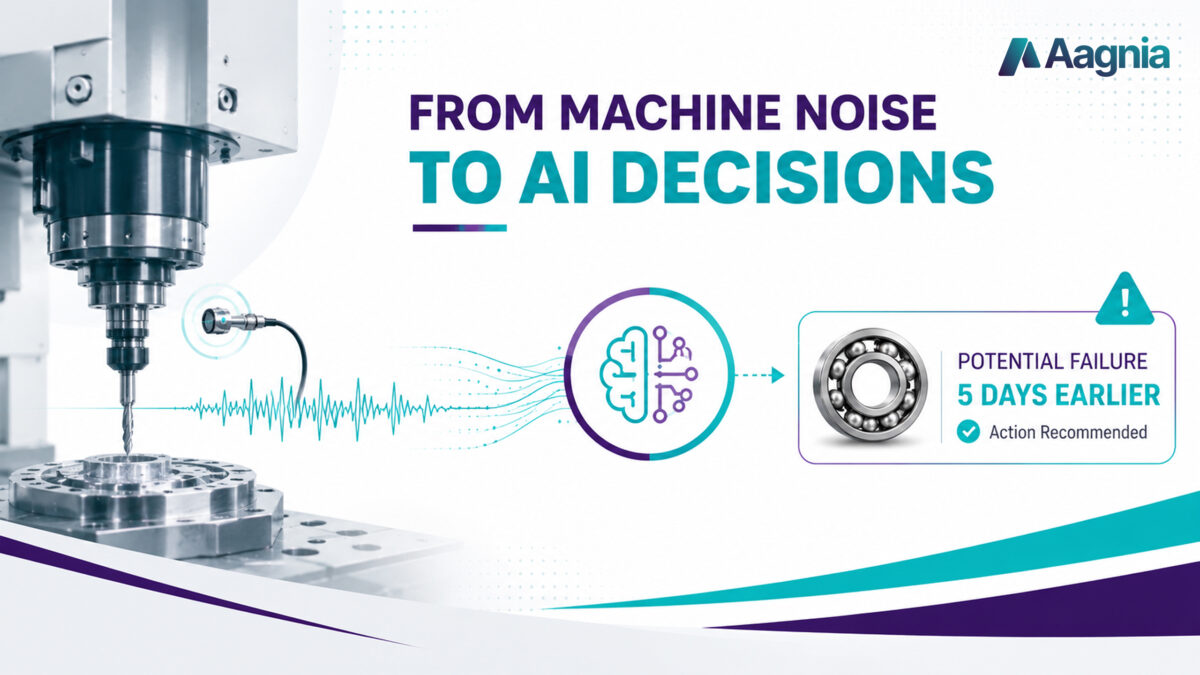
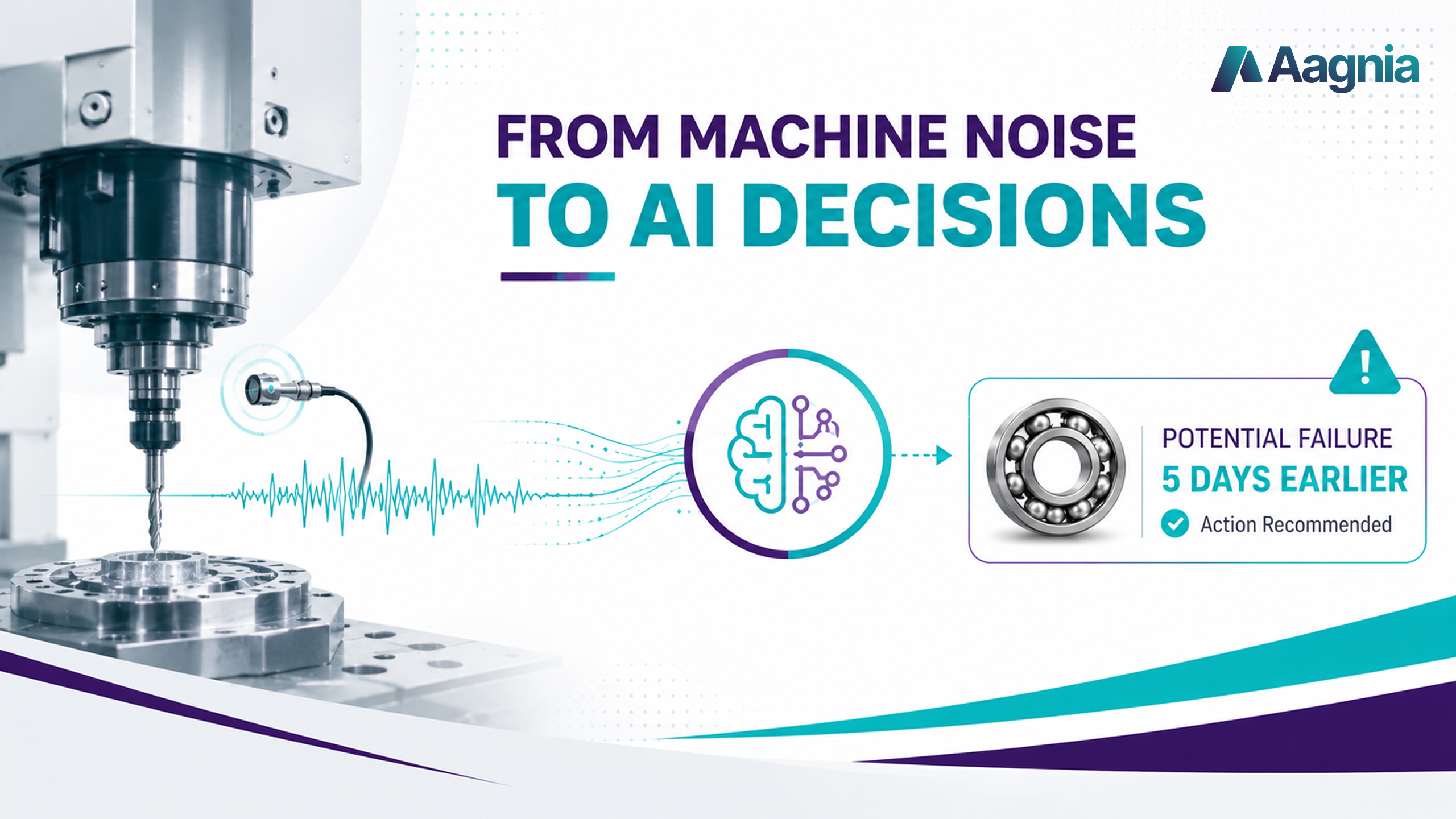
From Machine Noise to AI Decisions

What if your factory could detect equipment degradation before it causes an unexpected breakdown?

Predictive maintenance combines Industrial IoT, machine data, analytics, and AI to identify changing equipment conditions and support proactive maintenance decisions.

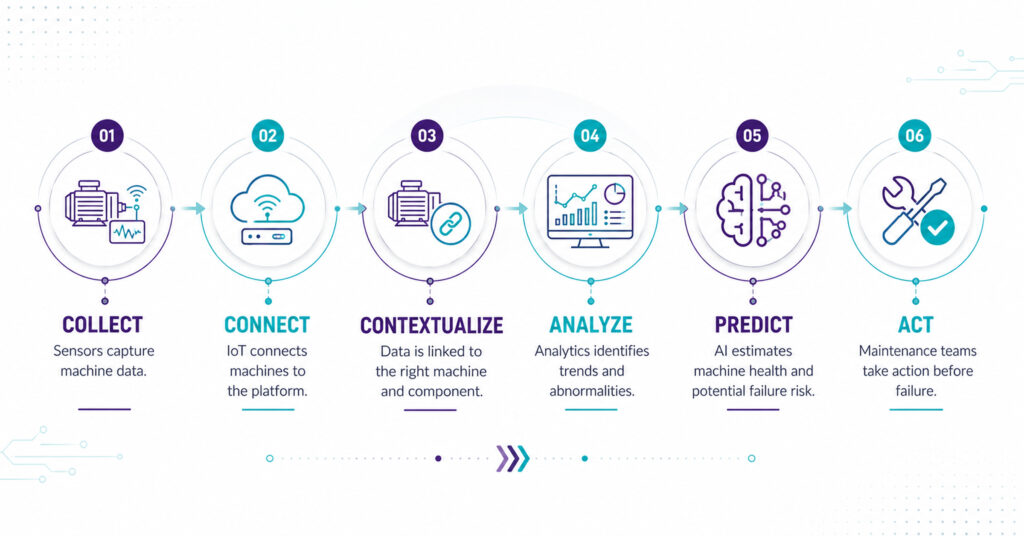
The journey can be summarized as:

Collect → Connect → Contextualize → Analyze → Predict → Act

What Happens When a Critical Machine Fails?

A CNC machine suddenly stops during production.

The spindle bearing has failed.

Production stops. Operators wait. Maintenance responds urgently. Spare parts may need to be sourced, and delivery schedules can be affected.

But what if the machine had already been showing warning signs?

Predictive maintenance helps manufacturers identify those signals early, giving maintenance teams more time to investigate, plan, and respond.

Meet CNC-001

Machine: CNC-001
Operation: Rotor Turning
Critical Component: Spindle Bearing
Spindle Speed: 3,500 RPM

The spindle bearing is critical to smooth and reliable machine operation.

Sensors continuously monitor parameters such as:

  • Vibration
  • Temperature
  • Motor current
  • Spindle speed
  • Machine status

Think of sensors as a smartwatch for the machine—continuously capturing its condition.

Step 1: Collect -The Machine Starts Talking

Sensors generate real-time machine data.

For example:

Vibration: 2.31 mm/s
Temperature: 58°C

A single reading tells us very little.

But collecting these measurements continuously creates a history of how the machine behaves over time.

The journey begins:

Machine → Sensors → Raw Data

The more consistently machine signals are captured, the better the foundation for monitoring and analysis.

Step 2: Connect – IoT Bridges the Factory Floor

Machine data needs to move from industrial equipment into an IoT platform.

An Edge IoT Gateway acts as the connection layer between machines and software.

The architecture is:

Machine & Sensors
↓
Edge IoT Gateway
↓
IOT3Sixty Platform

The gateway helps collect, transfer, and process industrial machine information so it can be used by applications and analytics.

Step 3: Contextualize – Give Data Meaning

A value such as 58 means very little by itself.

But when the system knows:

  • Plant: Plant 1
  • Line: Rotor Line
  • Machine: CNC-001
  • Component: Spindle Bearing
  • Parameter: Temperature
  • Value: 58°C
  • Timestamp: 10:32 AM

the number becomes meaningful.

Context turns data into information.

IOT3Sixty connects machine measurements with their operational context so teams can understand what happened, where, when, and to which asset.

Step 4: Analyze – AI Finds the Pattern

Traditional monitoring often asks:

“Did the value cross a threshold?”

Predictive analytics asks a bigger question:

“Is the machine’s behavior changing?”

AI can analyze:

  • Historical sensor data
  • Operating conditions
  • Running hours
  • Maintenance history
  • Previous failure patterns

For CNC-001, gradually increasing vibration and temperature together may reveal a developing equipment condition.

Threshold Monitoring

Value crosses limit → Alert

Predictive Analytics

Pattern changes → Investigate potential degradation

The difference is important. Traditional threshold monitoring focuses on whether a predefined limit has been crossed, while predictive analytics looks for changes and patterns in equipment behavior.

Step 5: Predict -Look Beyond the Current Condition

Once patterns are identified, predictive maintenance can provide equipment-health indicators such as:

Health Score

64%

Indicates the current level of equipment concern based on the available analysis.

Risk Level

Indicates the current level of equipment risk or concern.

Failure Probability

Estimates the likelihood of a potential failure condition.

Remaining Useful Life

Estimated RUL: 120 hours

RUL is an estimate, not an exact countdown.

Its purpose is to help maintenance teams understand potential equipment life and make better planning decisions.

Step 6: Act – Turn Prediction Into Maintenance

Prediction alone does not prevent downtime.

The insight needs to become an action.

The maintenance decision may consider:

  • Production schedules
  • Planned shutdowns
  • Spare parts
  • Technician availability
  • Maintenance windows

For CNC-001, the recommendation could be:

“Replace the spindle bearing during Wednesday’s planned shutdown.”

Instead of waiting for an unexpected failure, the team can prepare and act during a planned maintenance window.

AI Insight → Maintenance Action → Reduced Unplanned Downtime

The Complete Predictive Maintenance Journey

The complete journey moves from machine data to maintenance action:


Why Predictive Maintenance Matters

When machine condition becomes visible and actionable, manufacturers can improve several areas of their operations.

Equipment Reliability

Identify developing equipment issues earlier and understand changing machine conditions.

Maintenance Planning

Schedule maintenance around production requirements and planned shutdowns.

Spare-Part Planning

Prepare required parts before emergency repairs are needed.

Production Continuity

Reduce disruption caused by unexpected equipment failures.

Maintenance Costs

Reduce the operational impact of emergency interventions and unplanned maintenance.

Delivery Reliability

Keep production schedules more predictable by reducing unexpected equipment-related disruptions.

Predictive maintenance is ultimately about turning equipment data into better operational decisions.


Compliance and Regulatory Requirements:

In today’s regulatory landscape, businesses must comply with various data protection and privacy regulations. Regular application maintenance plays a critical role in meeting these compliance requirements. By conducting security audits, implementing necessary controls, and ensuring data integrity, businesses can demonstrate their commitment to protecting user information and avoid legal consequences.

Conclusion:

Predictive maintenance gives manufacturers a way to move beyond simply reacting to equipment failures.

By continuously collecting machine data, connecting equipment through Industrial IoT, adding operational context, analyzing patterns, and turning insights into planned maintenance actions, manufacturers can gain a clearer understanding of equipment condition.

The goal is not to predict every failure with certainty. It is to provide maintenance teams with better information earlier, so they can make more informed maintenance decisions.

Know the condition. Understand the pattern. Act earlier.

Turn Machine Data Into Maintenance Insights

Want to turn machine data into actionable maintenance insights?

Explore how IOT3Sixty can help you build a smarter predictive maintenance strategy.

Categories
IoT Preventive Maintenance

IOT3Sixty MES for Downtime Tracking and Analysis

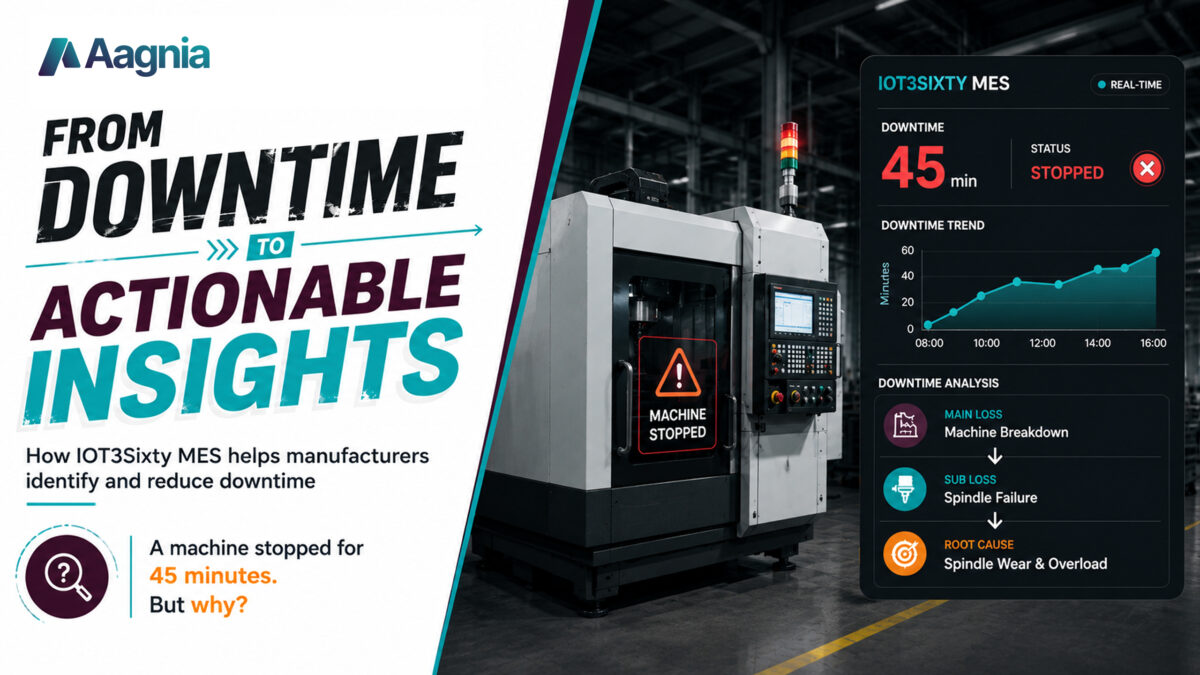
From Machine Downtime to Actionable Insights

A machine stops.

Production slows down.

The supervisor knows there is downtime — but the bigger question is:

Why did it happen, and how can we prevent it from happening again?

For many manufacturing organizations, identifying the exact reason behind downtime can be difficult when production information is captured manually or across disconnected systems.

This is where IOT3Sixty MES helps manufacturers bring greater visibility to shop-floor operations and understand the reasons behind production losses.

The Challenge: Knowing That a Machine Stopped Is Not Enough

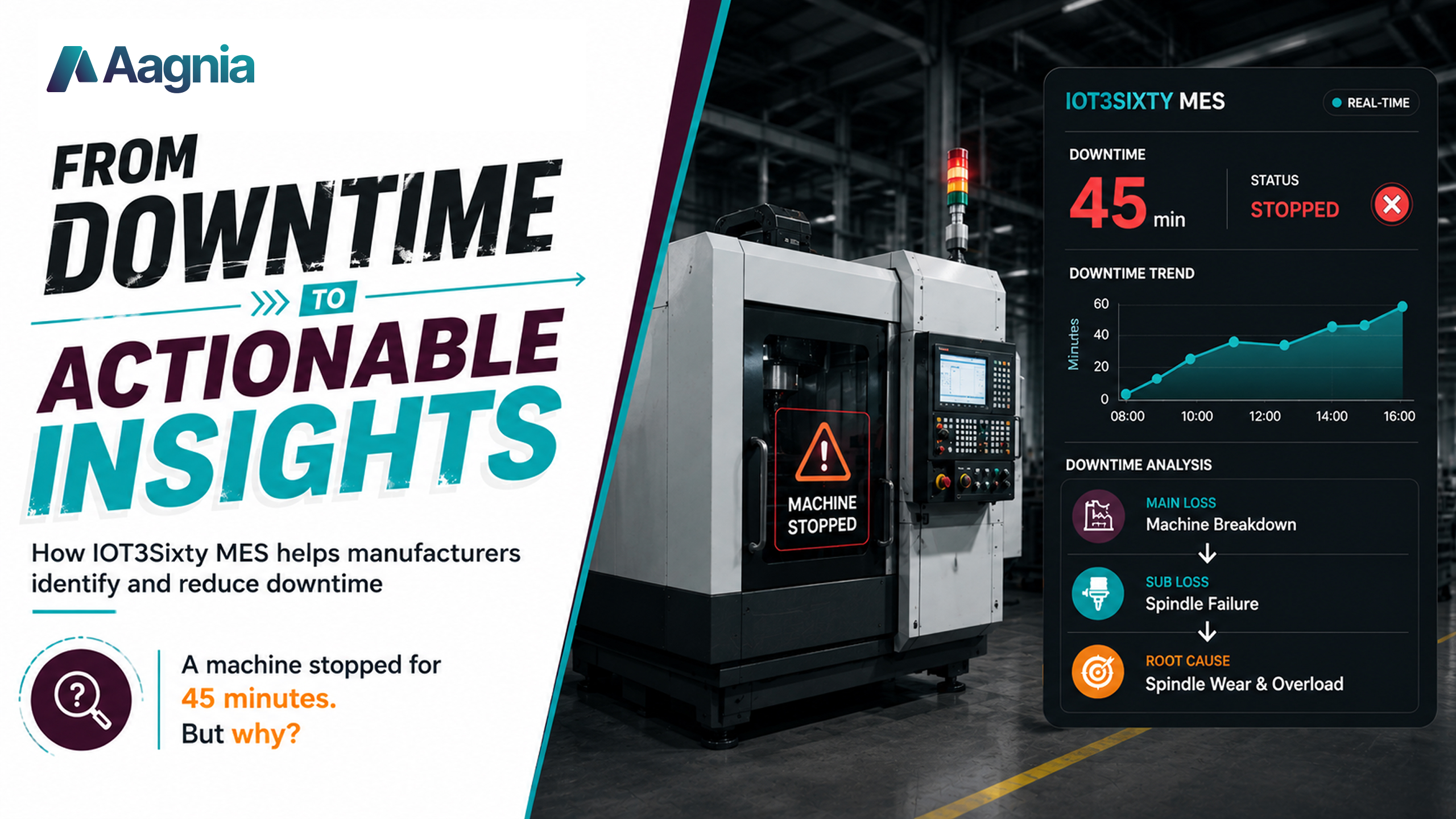
Imagine a CNC machine stops for 45 minutes.

The production team records:

Downtime: 45 minutes

But that information alone does not explain what happened.

Was it:

  • Machine breakdown?
  • Tool failure?
  • Material unavailability?
  • Changeover?
  • Quality issue?
  • Operator-related delay?
  • Maintenance activity?

When the reason is unclear, identifying recurring production losses becomes difficult.

How IOT3Sixty MES Addresses the Problem

IOT3Sixty MES helps capture downtime information in a structured way using Main Loss and Sub Loss classification.

Instead of simply recording that a machine stopped, production teams can identify the category and specific reason behind the loss.

For example:

Machine Downtime → Machine Breakdown → Spindle Failure

This transforms basic downtime information into meaningful shop-floor data.

From "Machine Stopped" to "Why It Stopped"

With IOT3Sixty MES, manufacturers can build a clearer connection between the production event and its underlying reason.

Downtime Analysis Workflow

Machine Stops
↓
Downtime Captured
↓
Main Loss Identified
↓
Sub Loss Selected
↓
Reason Categorized
↓
Production Team Analyzes the Loss
↓
Corrective Action

This structured approach makes it easier for supervisors and production managers to understand where valuable production time is being lost.

Turning Downtime Data into Improvement Opportunities

The objective is not simply to maintain a list of downtime events.

The real value comes from analyzing the information over time.

With structured downtime data, manufacturers can identify:

  • Frequently occurring breakdown reasons
  • Machines with repeated downtime
  • Major sources of production loss
  • Recurring material-related delays
  • Changeover-related losses
  • Quality-related interruptions
  • Areas requiring maintenance or process improvement

For example, instead of saying:

“The machine had frequent downtime.”

the production team can identify:

“This machine is repeatedly losing production time because of the same breakdown category.”

That gives the team a much clearer starting point for investigation and corrective action.

From Downtime Data to Corrective Action

Structured downtime information creates a clearer path from an event on the shop floor to an improvement opportunity.

Without Structured MES Visibility

Machine Stops
↓
Downtime Recorded
↓
Reason Unclear
↓
Manual Investigation
↓
Delayed Improvement

With IOT3Sixty MES

Machine Stops
↓
Downtime Captured
↓
Main Loss Identified
↓
Sub Loss Identified
↓
Downtime Patterns Become Visible
↓
Teams Take Informed Corrective Action

Image: This comparison can be presented as a two-column infographic: Without Structured MES Visibility vs With IOT3Sixty MES.

How IOT3Sixty MES Helps

Manufacturing improvement starts with reliable information.

When downtime reasons are recorded consistently, production teams can move away from assumptions and manual investigation toward data-driven decision-making.

This can help organizations:

Identify → Analyze → Correct → Improve

Instead of asking only:

“How long was the machine down?”

teams can start asking:

“What caused the loss, how often is it happening, and what can we do to reduce it?”

Supporting OEE and Production Performance

Downtime visibility is also an important part of OEE (Overall Equipment Effectiveness) and production performance monitoring.

By capturing production losses systematically, IOT3Sixty MES can help organizations better understand the Availability component of equipment performance and identify opportunities to improve machine utilization.

Better visibility can support:

Less Unplanned Downtime → Better Machine Availability → Improved Production Efficiency

From Downtime Data to Corrective Action

Structured downtime information creates a clearer path from an event on the shop floor to an improvement opportunity.

Without Structured MES Visibility

Machine Stops
↓
Downtime Recorded
↓
Reason Unclear
↓
Manual Investigation
↓
Delayed Improvement

With IOT3Sixty MES

Machine Stops
↓
Downtime Captured
↓
Main Loss Identified
↓
Sub Loss Identified
↓
Downtime Patterns Become Visible
↓
Teams Take Informed Corrective Action

How IOT3Sixty MES Helps

Through IOT3Sixty MES, manufacturers can connect shop-floor execution with meaningful production insights.

The focus is not simply on recording what happened on the production floor.

It is about creating better visibility into production losses, helping teams understand downtime patterns, and providing the information needed to support continuous improvement.

Conclusion:

Downtime is more than lost production time — it is valuable operational data.

When manufacturers capture and classify that data effectively, every downtime event can become an opportunity to understand the production process better.

With IOT3Sixty MES, manufacturers can move from simply knowing that a machine stopped to gaining clearer visibility into why it stopped and where improvement is needed.

Know the loss. Understand the reason. Improve the process.

Categories
IoT Preventive Maintenance

Production Planning and Shop Floor Execution

Turning Production Plans into Real-Time Shop Floor Visibility

A production plan can look perfect on paper.

But what happens when the job reaches the shop floor?

Is the right machine ready? Is the operation completed on time? Where is the delay? What is happening right now?

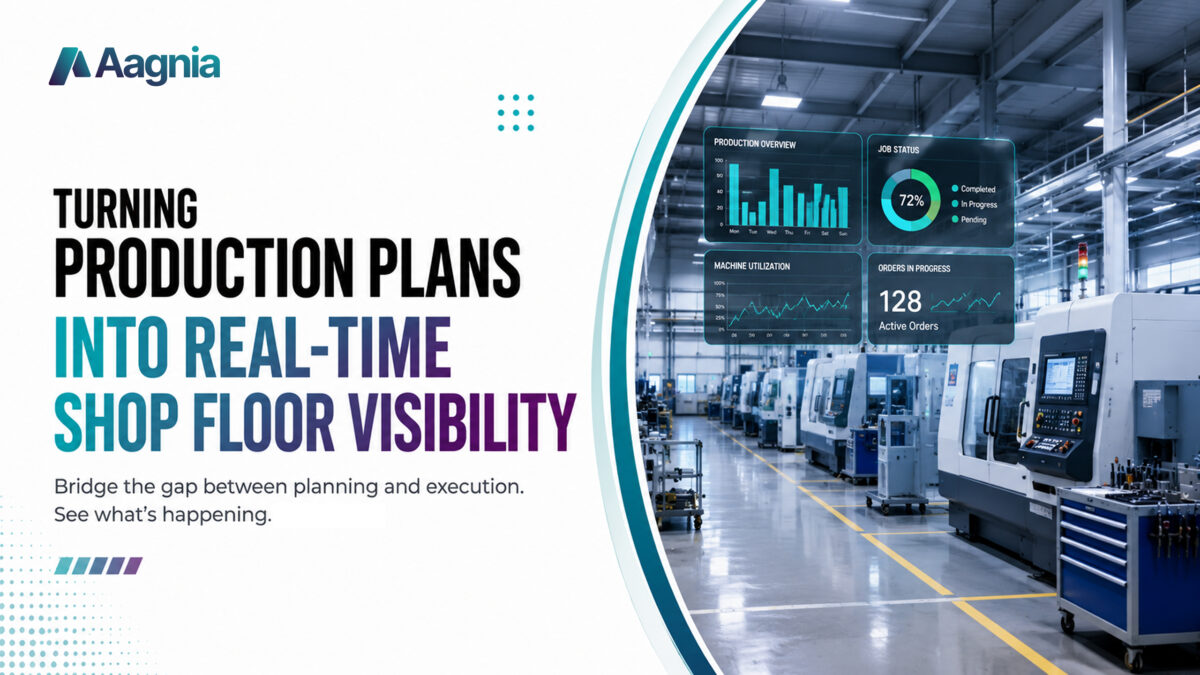
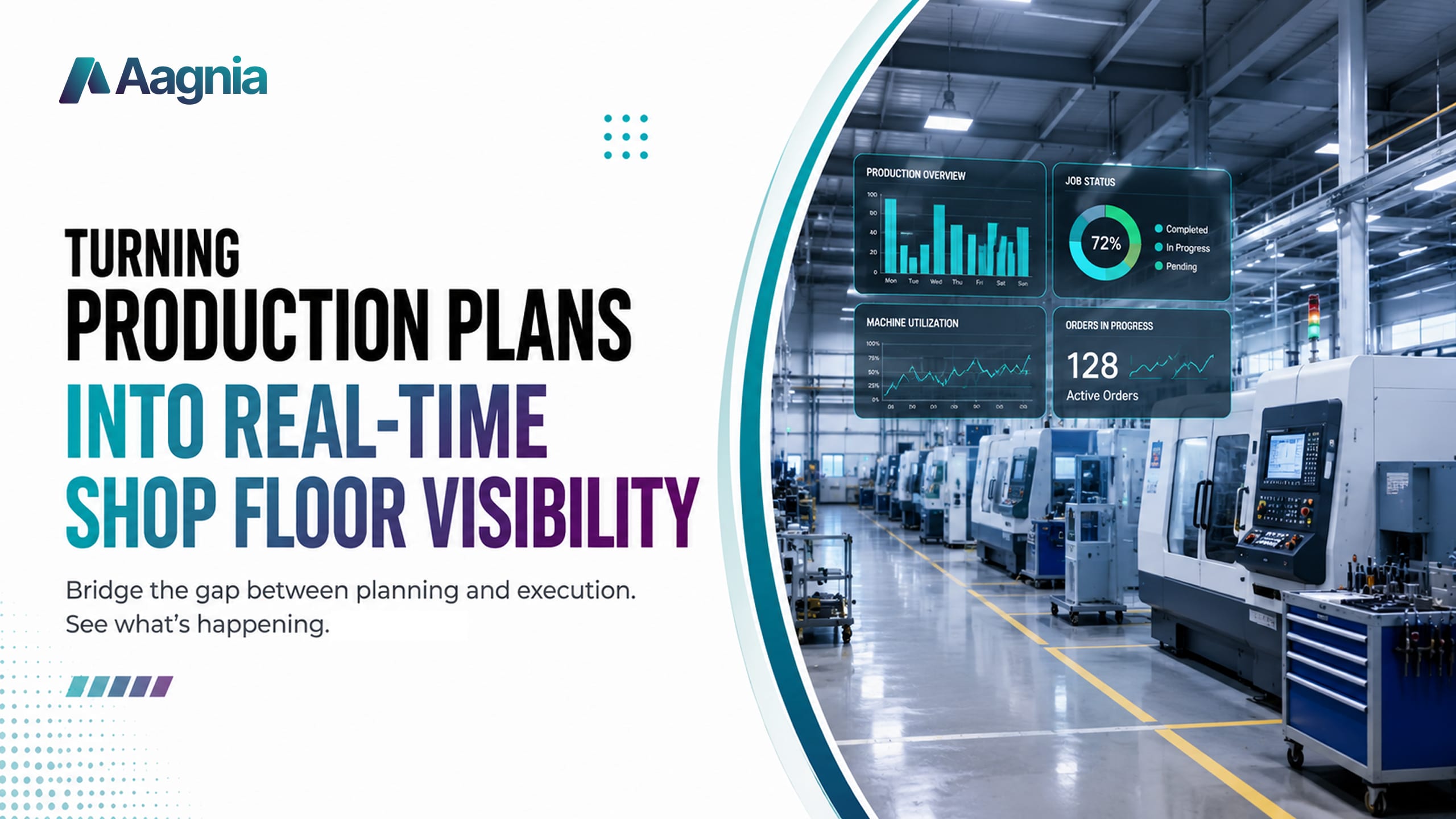
This is where many manufacturing teams face a gap between production planning and actual execution.

A connected manufacturing workflow can help bridge that gap.

From Plan to Execution

With IOT3Sixty, the production workflow connects:

Production Order → Production Mapping → Production Stage → Operation Tracking

Production Order – Define what needs to be produced.

Production Mapping – Connect jobs with operations and resources.

Production Stage – Know where each production job stands.

Operation Tracking – Monitor actual shop-floor execution.

The result?

  • Better production visibility
  • Improved shop-floor control
  • Faster identification of bottlenecks
  • Clear operational accountability
  • Better alignment between planning and execution

The goal isn’t simply to plan production.

It’s to connect the plan with what is actually happening on the shop floor.

At Aagnia Technologies, we focus on helping businesses move toward more connected, visible, and efficient manufacturing operations through practical digital solutions.


Conclusion:

Bridging the gap between production planning and shop-floor execution gives manufacturers better visibility into what is happening on the production floor.

By connecting production orders, production mapping, production stages, and operation tracking, teams can identify delays faster, improve coordination, and maintain better control over daily production activities.

The goal is not just to create better production plans, but to ensure those plans remain connected to real-time shop-floor execution.

Better visibility. Better coordination. Better manufacturing control.

Categories
IoT Preventive Maintenance

Manufacturing Execution System (MES): Smart Factory Solution

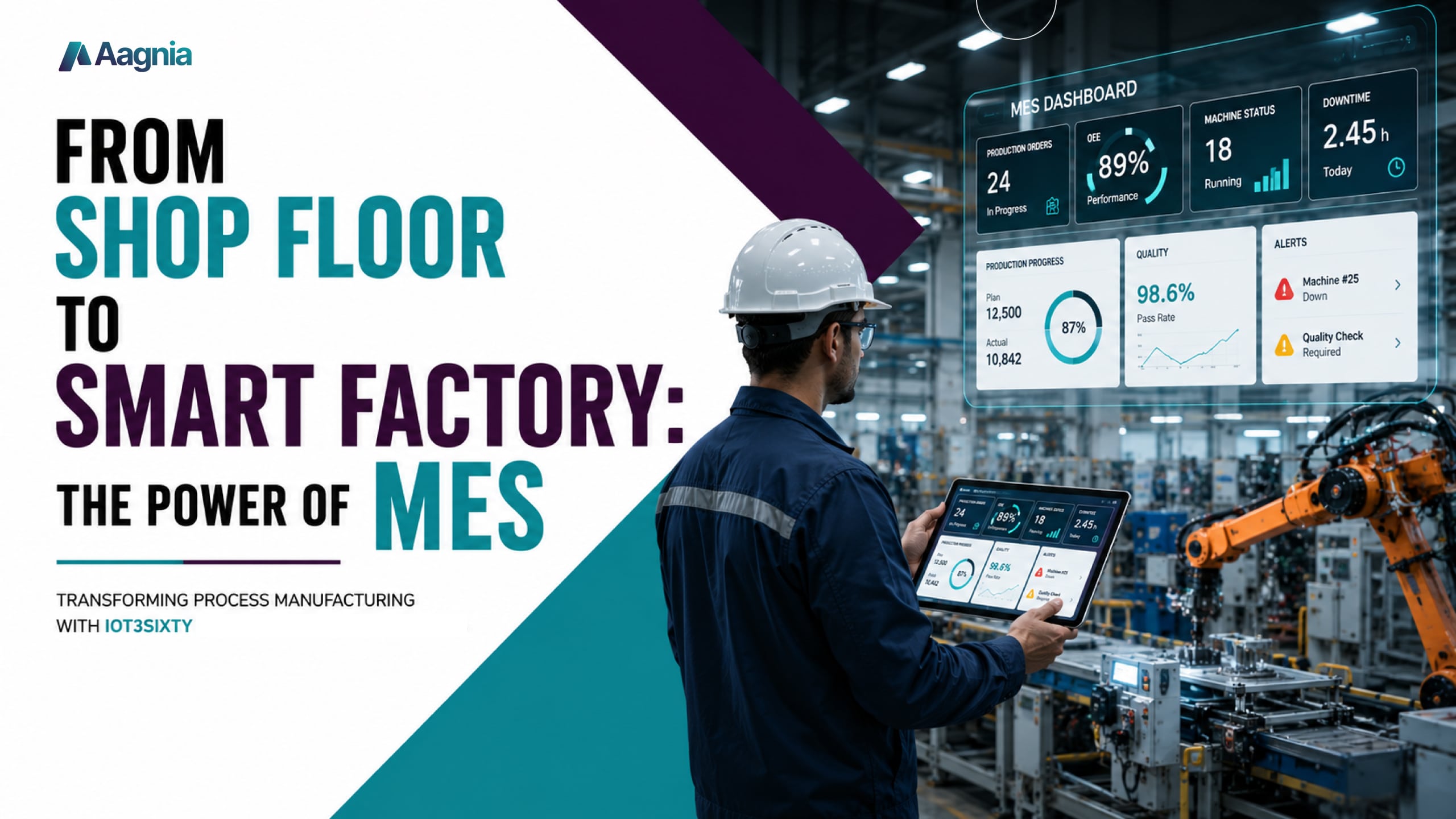
Smart Manufacturing Starts on the Shop Floor: Why Modern Factories Need MES

A production plan can look perfect at 9 AM.

But by noon, reality may look very different.

A machine has stopped unexpectedly. Material consumption is higher than planned. A batch is running behind schedule. Quality needs attention. And the production manager is still waiting for the latest update.

This is one of the biggest challenges manufacturers face today:

There is often a gap between what was planned and what is actually happening on the shop floor.

That is exactly where a Manufacturing Execution System (MES) creates value.

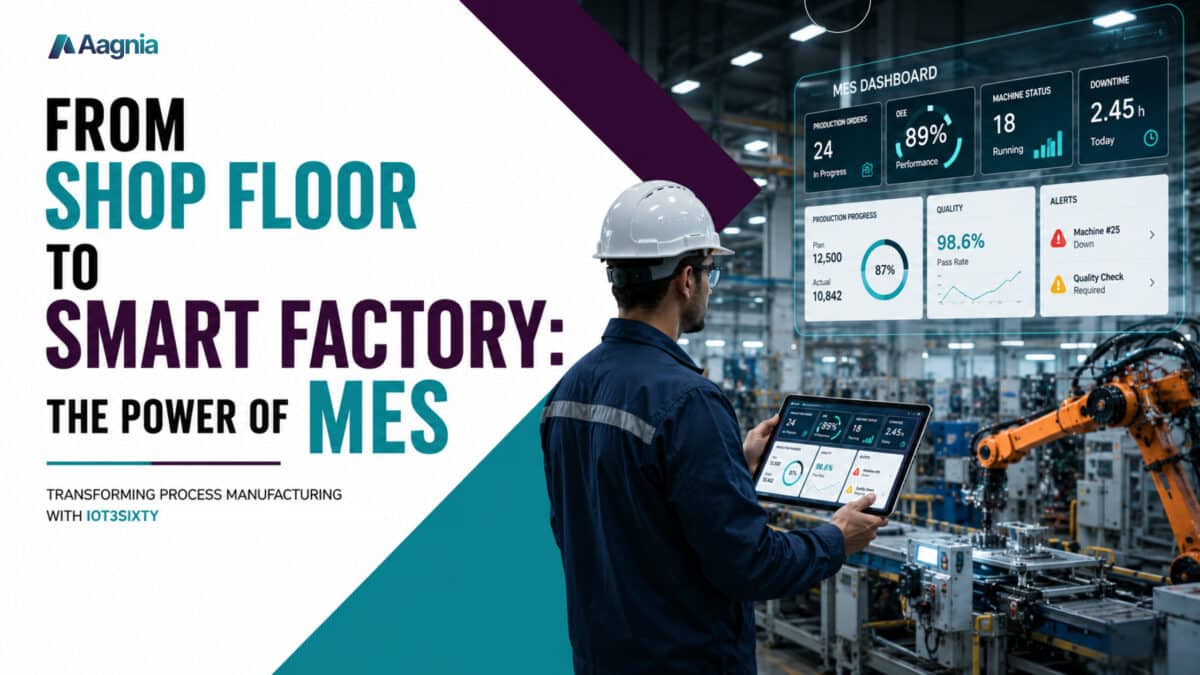
An MES helps connect production activities, machines, materials, quality, and performance information within a more unified manufacturing environment.

What Does MES Actually Do?

ERP is excellent at answering:

“What are we planning to manufacture?”

MES goes closer to the shop floor and helps answer:

“What is happening in production right now?”

Machines Shouldn't Operate Like Information Islands

Knowing whether a machine is ON or OFF is only the beginning.

Manufacturers also need to understand:

  • How long was the machine running?
  • When did production stop?
  • What caused the downtime?
  • How is the equipment performing?
  • Is the machine delivering the expected output?

With machine monitoring and Industrial IoT (IIoT), equipment data can become part of the wider manufacturing picture.

Instead of finding problems at the end of the shift, teams can identify operational issues much closer to when they occur.

Material Visibility Matters Just as Much

For process manufacturers, material consumption directly influences production cost, traceability, and output.

Production teams need to know:

What was issued → What was consumed → Where it was consumed → What was produced

Connecting material information with production execution creates stronger batch and material traceability while reducing dependency on manually consolidated records.

Quality Shouldn’t Wait Until Production Ends

Quality control works best when it becomes part of production — not simply the final step.

When inspection information is connected with manufacturing execution, teams can identify deviations earlier and respond before they create a larger production problem.

The goal should be:

Detect Earlier → Respond Faster → Produce Better

This approach makes quality information part of the production workflow rather than something reviewed only after production is completed.

Understanding OEE Through Production Data

Producing 1,000 units doesn’t automatically mean a machine performed efficiently.

There could have been downtime.

The machine may have operated below its expected speed.

Some of the output may have failed quality requirements.

That’s why Overall Equipment Effectiveness (OEE) remains such an important manufacturing KPI.

OEE = Availability × Performance × Quality

OEE gives production teams a clearer picture of where manufacturing capacity is actually being lost.

And that leads to better questions:

  1. Why did the machine stop?
  2. Why did production slow down?
  3. Where are we losing productive time?
  4. How much output met our quality expectations?

These questions turn production data into opportunities for improvement.

From Production Data to Manufacturing Intelligence

Factories already generate a huge amount of information.

The challenge isn’t generating more data.

The challenge is turning that data into decisions.

A connected manufacturing dashboard can help teams bring together information around:

  • Production progress
  • Machine activity
  • Downtime
  • Material consumption
  • Quality
  • OEE
  • Manufacturing performance

Instead of spending time collecting updates from different sources, decision-makers can focus on understanding what needs attention now.

ERP + MES + IoT: A More Connected Factory

Smart manufacturing isn’t about replacing every existing system.

It’s about making different layers work together.

ERP → Business & Production Planning

MES → Shop-Floor Execution & Production Monitoring

IIoT → Machine & Operational Data

Analytics → Performance Insights & Better Decisions

When these layers connect, information can move more effectively between management and the shop floor.

That’s a major step toward Industry 4.0 and smart manufacturing.

A Smart Factory Starts With Visibility

When we hear the words Smart Factory, it’s easy to imagine robots, AI, and fully automated production lines.

But there’s something more fundamental.

Before a factory can become intelligent, it needs to understand its own operations.

  1. What are we producing?
  2. Which materials are being consumed?
  3. How are our machines performing?
  4. Where are we losing production time?
  5. Are we meeting quality expectations?
  6. Are we achieving our production targets?

These questions form the foundation of a more connected and data-driven manufacturing environment.

Building a More Connected Manufacturing Environment

With IoT3Sixty MES, the goal is to bring people, machines, materials, processes, and production data closer together within a connected manufacturing environment.

Digital transformation on the shop floor isn’t simply about introducing more technology.

It’s about seeing production clearly enough to make better decisions.

Conclusion:

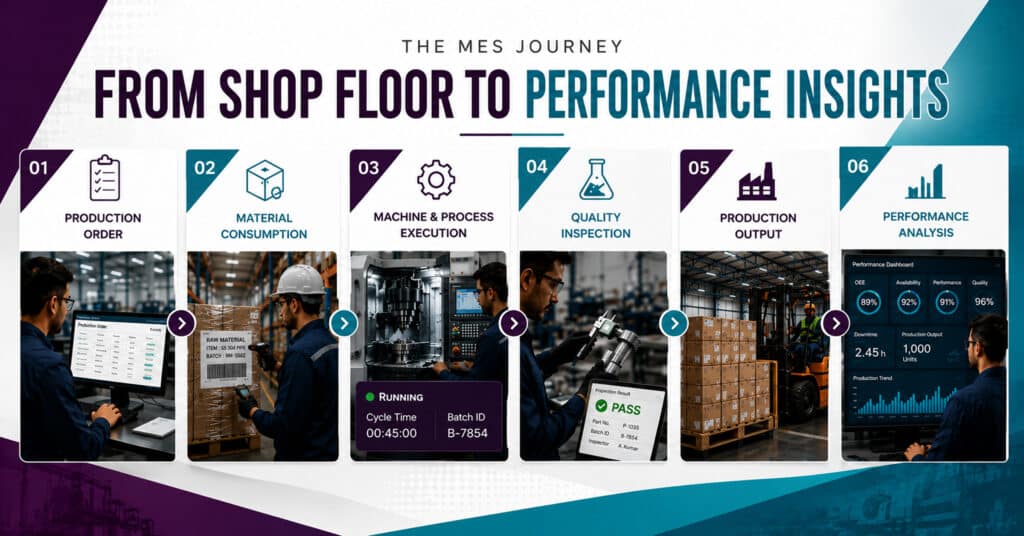
A Manufacturing Execution System helps close the gap between production planning and what is actually happening on the shop floor.

By connecting production orders, material consumption, machine execution, quality inspection, production output, and performance analysis, manufacturers can gain greater visibility into their operations.

When MES works together with ERP, IIoT, and analytics, manufacturers can move toward a more connected, data-driven approach to production.

Connect Production. Understand Performance. Improve Manufacturing.

Categories
IoT Preventive Maintenance

Warehouse Management System (WMS) for Smarter Warehouses

Empowering Businesses with Smarter Warehouse Operations

A warehouse doesn’t become efficient simply by storing inventory — it becomes efficient when every movement is visible, traceable, and controlled.

Many businesses still struggle with inventory inaccuracies, manual tracking, and limited visibility across warehouse operations. The solution isn’t adding more spreadsheets — it’s building a connected warehouse with a robust Warehouse Management System (WMS).

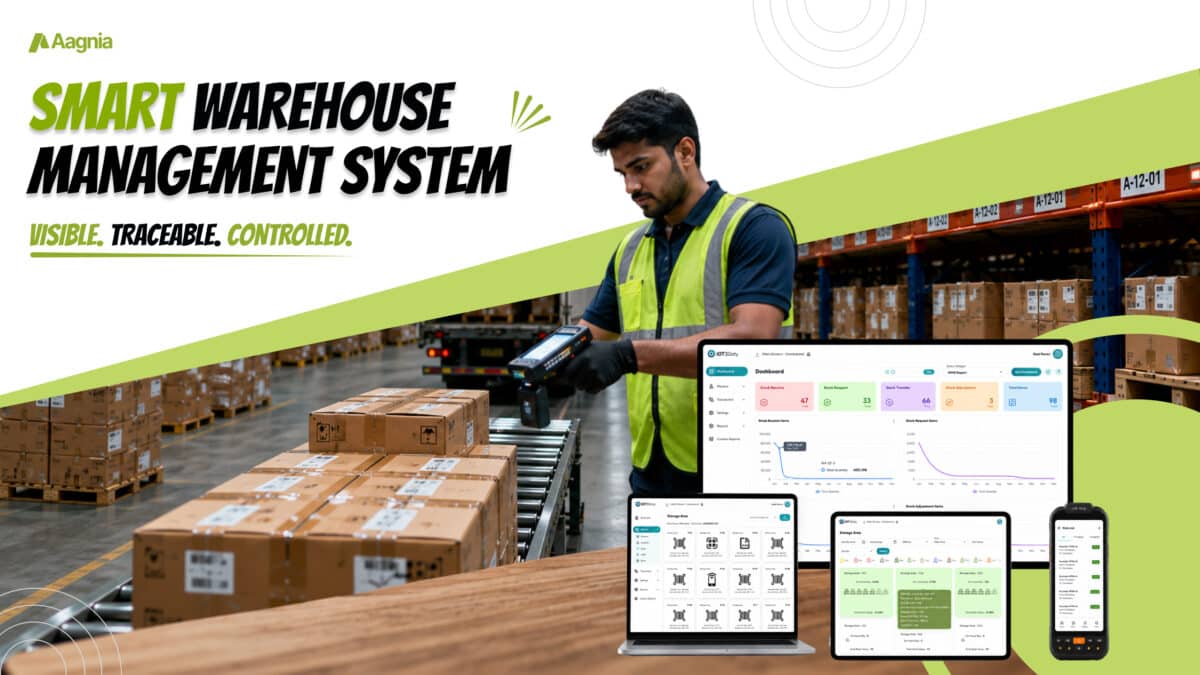
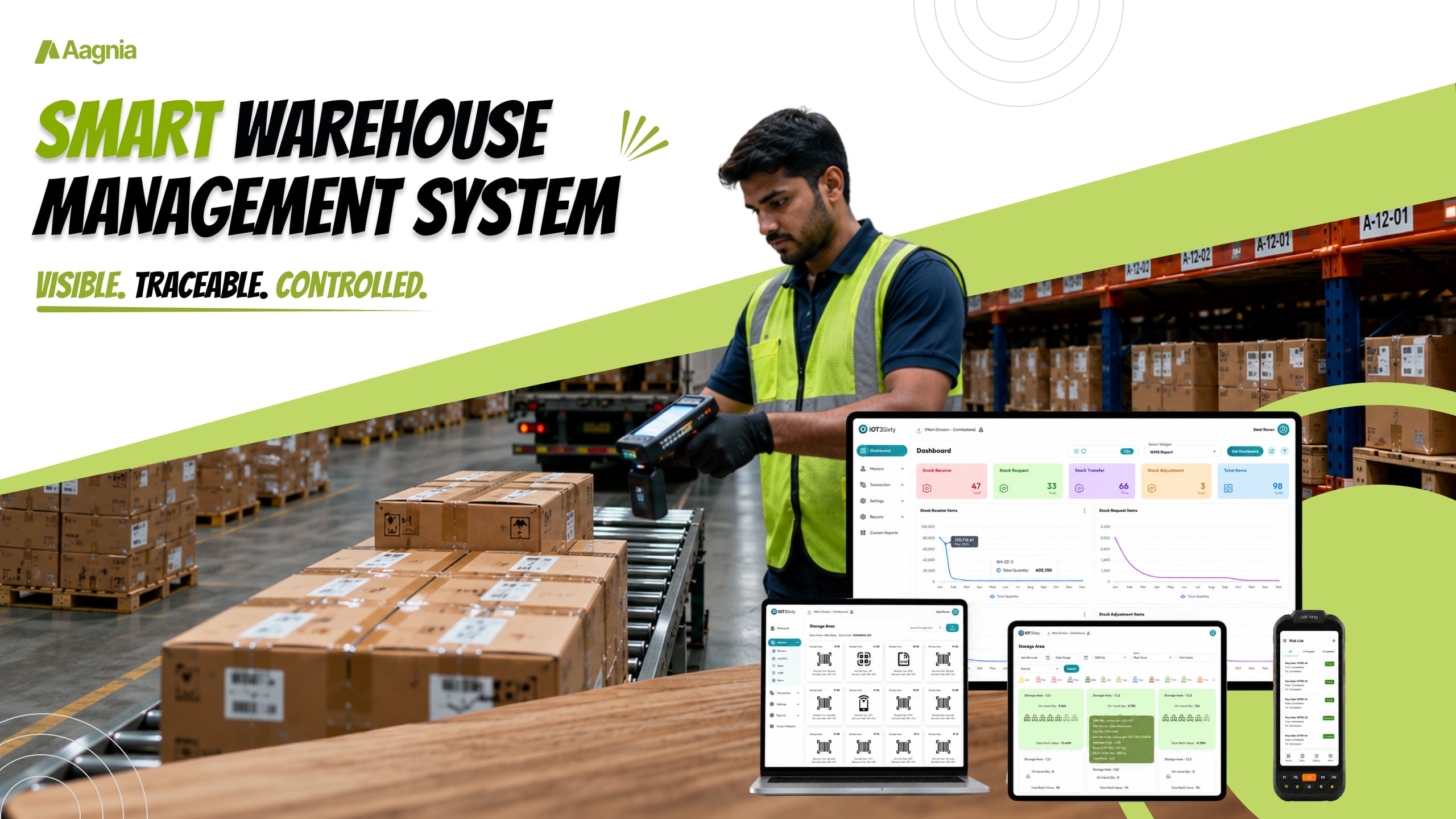
At IoT3Sixty, a product from Aagnia Technologies, we’ve developed a Warehouse Management System (WMS) that helps organizations simplify warehouse operations through structured workflows, centralized data, and real-time visibility.

Building a Connected Warehouse with WMS

A modern warehouse needs more than basic inventory tracking. It needs a system that connects inventory, locations, transactions, users, and reports into a structured operational workflow.

IoT3Sixty WMS provides the tools businesses need to manage warehouse operations more efficiently and maintain better visibility across their inventory.

What Does Our WMS Enable?

Real-Time Dashboard

A real-time dashboard provides a centralized visual interface for monitoring stock levels, warehouse activities, and operational metrics.

With live data updates, teams can monitor inventory, track warehouse activities, and analyze operational performance more efficiently.

Master Data Management

A strong warehouse operation starts with well-structured master data.

The WMS provides master data management for:

  • Divisions
  • Locations
  • Zones
  • Units of Measure (UOM)
  • Items

This establishes a structured operational foundation and helps maintain consistency across warehouse processes.

Seamless Inventory Transactions

Warehouse inventory moves through multiple stages every day. Managing these movements manually can create discrepancies and make traceability difficult.

The WMS supports seamless inventory transactions, including:

  • Stock Receive
  • Stock Transfer
  • Stock Request
  • Location Receive
  • Stock Adjustment

By managing these activities through structured workflows, businesses can maintain better control over inventory movements.

Configurable System Settings

Every business has different warehouse requirements.

IoT3Sixty WMS provides configurable system settings that allow businesses to adapt the system to their operational needs.

These include:

  • General Configuration
  • Sequence Configuration
  • Color Code Customization

This flexibility helps organizations configure warehouse workflows according to their specific requirements.

Comprehensive Warehouse Reports

Visibility doesn’t stop with inventory transactions.

The WMS provides comprehensive reports covering key warehouse activities, including:

  • Storage Area
  • Stock Receive
  • Stock Transfer
  • Stock Request
  • Location Performance
  • Inventory Insights

These reports help teams understand warehouse activity and make decisions using structured operational information.

Custom Reporting Engine

Different businesses require different types of reports.

The custom reporting engine allows businesses to generate tailored reports using:

  • Filters
  • Grouping
  • Export capabilities

This provides greater flexibility when analyzing warehouse data and creating reports based on specific operational requirements.

Why a Warehouse Management System Matters

A well-designed Warehouse Management System is more than a tool for inventory tracking.

It helps create standardized processes, improve stock accuracy, enhance traceability, and provide the visibility needed for faster, data-driven decisions.

When warehouse activities are managed through connected workflows, teams can spend less time searching for information and more time managing operations effectively.

Creating a Strong Foundation for Warehouse Modernization

As warehouses continue evolving, digital transformation starts with building a strong operational foundation.

When inventory, locations, transactions, and reporting work together seamlessly, businesses gain better visibility into their warehouse operations and the confidence to scale efficiently.

A connected WMS can help bring structure to everyday warehouse activities while providing the information teams need to manage inventory and make informed operational decisions.

Compliance and Regulatory Requirements:

In today’s regulatory landscape, businesses must comply with various data protection and privacy regulations. Regular application maintenance plays a critical role in meeting these compliance requirements. By conducting security audits, implementing necessary controls, and ensuring data integrity, businesses can demonstrate their commitment to protecting user information and avoid legal consequences.

Conclusion:

Warehouse efficiency depends on more than how much inventory a business can store. It depends on how effectively that inventory can be received, moved, tracked, managed, and reported.

With a connected Warehouse Management System, businesses can move away from fragmented tracking and manual processes toward a more structured and visible warehouse operation.

IoT3Sixty WMS brings together inventory management, warehouse transactions, master data, configurable settings, and reporting to help businesses build a more connected approach to warehouse management.

Categories
insights IoT Preventive Maintenance

Smart Factories: WMS, MES, AI & Real-Time Data

Every manufacturing facility generates thousands of data points every day.

But here’s the real question:

Is your data helping you make faster decisions — or simply creating more complexity?

Many manufacturers still rely on disconnected systems, manual reporting, and delayed updates. As a result, critical decisions are often made after production issues have already impacted quality, delivery, or costs.

Does This Sound Familiar?

  • Production data is scattered across multiple software applications.
  • Machine performance is tracked manually with delayed updates.
  • Inventory discrepancies slow down production planning.
  • Maintenance begins only after equipment fails.
  • Managers spend hours compiling reports instead of improving operations.

These aren’t technology problems – they’re connectivity problems.

When systems operate independently, valuable information remains isolated. Production teams may have one set of data, warehouse teams another, and management may have to wait for reports before getting a complete picture of operations.

Building a Connected Manufacturing Ecosystem

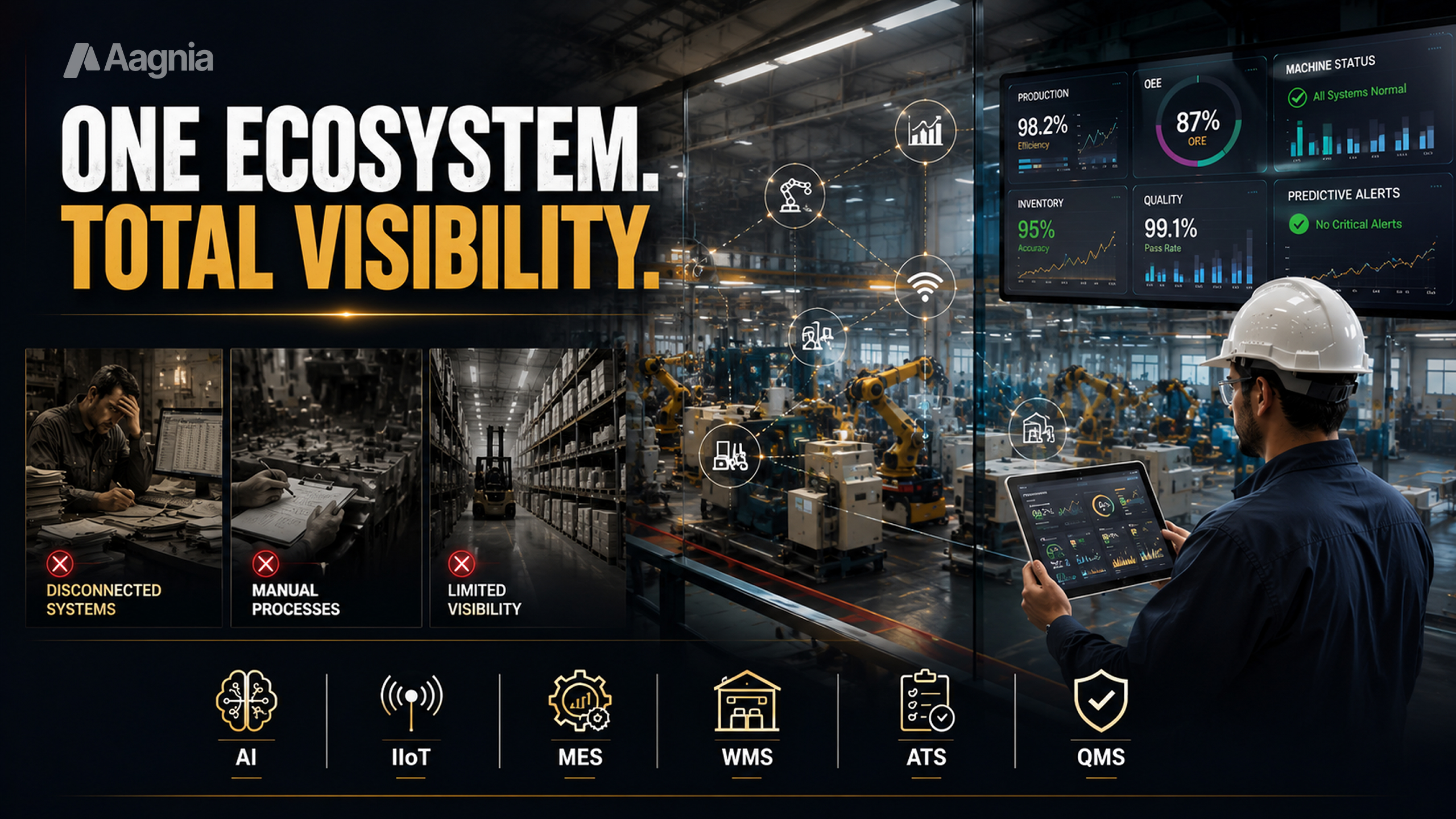
This is where AI, Industrial IoT, Warehouse Management Systems (WMS), and Manufacturing Execution Systems (MES) work together to create a truly connected manufacturing ecosystem.

Each technology addresses a different part of the manufacturing operation:

  • AI transforms production data into actionable insights and predicts potential issues.
  • Industrial IoT delivers real-time visibility into machines, assets, and operations.
  • WMS ensures accurate inventory, material movement, and warehouse efficiency.
  • MES connects production planning with shop-floor execution, enabling complete operational control.
  • Unified dashboards provide live insights for faster and smarter decision-making.
  • Predictive analytics reduce downtime and improve overall equipment effectiveness (OEE).

When these systems are connected, manufacturers can move beyond simply collecting data and start using it to understand what is happening across the factory.

Digital Transformation Doesn’t Have to Happen Overnight

The best part?

You don’t need to digitize your entire factory overnight.

Many successful manufacturers start with one production line, one warehouse, or a few critical machines. They measure the results, identify areas for improvement, and gradually expand the solution without disrupting daily operations.

This approach allows manufacturers to introduce new technologies while continuing their existing production activities.

Imagine the Difference

A connected manufacturing environment can provide:

  • Real-time visibility across production and warehouse operations
  • Reduced machine downtime through predictive maintenance
  • Improved inventory accuracy and material traceability
  • Faster production planning and execution
  • Better product quality with AI-driven insights
  • Lower operational costs and higher overall efficiency

The value isn’t simply in having more software or collecting more data.

It comes from connecting the right systems and making that information available to the people who need it.

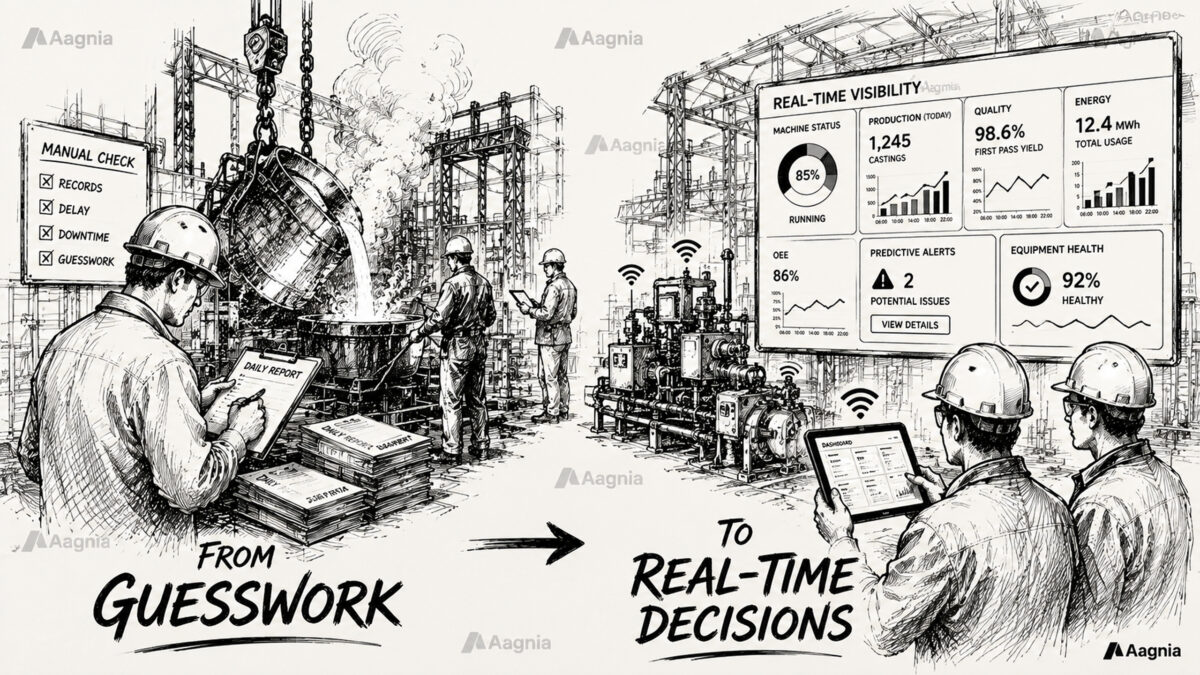
From Delayed Reports to Real-Time Decisions

Traditional manufacturing operations often depend on reports that are generated after an activity has already taken place.

By the time a problem appears in a report, the opportunity to prevent it may have already passed.

With connected systems, teams can access operational information closer to real time. Production performance, machine conditions, inventory movement, and other critical information can be brought together to support faster decisions.

This helps shift manufacturing operations from:

Manual updates → Connected data

Delayed reports → Real-time visibility

Reactive maintenance → Predictive maintenance

Disconnected systems → One connected ecosystem

Empowering People With Better Information

The future of manufacturing isn’t about replacing people — it’s about empowering them with the right information at the right time.

Operators can gain better visibility into machines and production. Warehouse teams can work with more accurate inventory information. Maintenance teams can identify potential issues earlier. Managers can make decisions using current operational data instead of waiting for multiple reports.

When people, machines, and systems are connected, technology becomes a tool for improving everyday manufacturing decisions.

Conclusion:

Smart manufacturing is not about adopting every technology at once.

It’s about connecting the systems that matter, making operational data accessible, and using that information to improve the way people work.

By bringing together AI, Industrial IoT, WMS, MES, and real-time reporting, manufacturers can build a more connected operation with greater visibility, faster decision-making, and better control across the factory.


If you could eliminate one manufacturing challenge today, what would it be — machine downtime, inventory visibility, production planning, quality control, or shop-floor connectivity?

Categories
insights IoT Preventive Maintenance

Industrial IoT for Foundries: Smarter, Connected Manufacturing

How Industrial IoT Is Helping Modern Foundries Work Smarter, Not Harder

Have you ever walked through a foundry and thought, “What if every machine could tell us exactly what’s happening right now?”

That is the reality many modern foundries are working toward.

Despite having skilled teams and years of industry experience, many foundry operations still depend on manual updates, paper records, spreadsheets, and disconnected machines. When something goes wrong, teams often discover the problem only after production has already been affected.

When Production Data Isn't Available in Real Time

Does any of this sound familiar?

  • A machine stops unexpectedly, and no one knows why until it is inspected.
  • Production data is spread across multiple systems and spreadsheets.
  • Quality issues are discovered only after an entire batch is completed.
  • Maintenance happens only after equipment breaks down.
  • Managers spend more time collecting reports than making decisions.

These challenges aren’t caused by a lack of experience. They are often the result of systems that were never designed to work together.

When machine data, production information, quality records, and maintenance activities remain disconnected, it becomes difficult to understand what is actually happening on the shop floor.

This Is Where Industrial IoT Makes a Difference

Industrial IoT connects machines, systems, and operational data to create a more connected and visible production environment.

Instead of treating every machine as a separate unit, Industrial IoT can connect the entire foundry into one intelligent ecosystem.

With the right Industrial IoT setup, foundries can:

  • Monitor critical machines in real time
  • Receive instant alerts when abnormal conditions occur
  • Track production, quality, and energy consumption from a single dashboard
  • Use AI-powered insights to identify patterns and trends
  • Move from reactive maintenance toward predictive maintenance
  • Give decision-makers access to live operational data

The goal isn’t simply to collect more data.

The goal is to turn machine and production data into information that teams can actually use to make faster decisions.

What Can a Connected Foundry Achieve?

Imagine having better visibility into what’s happening across the shop floor instead of waiting for end-of-shift reports.

A connected Industrial IoT environment can help support:

  • Less unexpected downtime
  • Better casting quality and consistency
  • Faster production decisions backed by live data
  • Lower maintenance and operating costs
  • Greater visibility across the shop floor
  • More time focused on improvement instead of firefighting

The value comes from connecting these capabilities together rather than relying on isolated systems.

From Reactive Operations to Proactive Decisions

The biggest shift Industrial IoT brings is not simply automation.

It is the ability to move from reacting to problems after they occur toward identifying potential issues earlier and making decisions using real-time information.

A machine’s condition, production performance, quality information, and maintenance data can provide a much clearer picture of what is happening across the operation.

Instead of asking:

“What happened?”

teams can start asking:

“What is happening now, and what should we do next?”

The Future of Foundry Operations

The future of foundries isn’t about replacing people.

It is about giving skilled teams the information they need, exactly when they need it.

Foundry operators and engineers already bring years of practical knowledge to the production floor. Industrial IoT can complement that expertise by providing real-time visibility into machines, production, quality, and maintenance.

When experience and real-time operational data work together, decisions can become faster, more informed, and more proactive.

Conclusion:

Industrial IoT is helping foundries move beyond disconnected machines, manual reporting, and reactive problem-solving toward more connected and data-driven operations.

The transformation doesn’t need to start with the entire factory. It can begin with one machine, one process, or one operational challenge and gradually expand as the benefits become clear.

The question is no longer whether your foundry can collect data. It’s how effectively you can use that data to make better decisions.

Categories
IoT Preventive Maintenance

How OEE Helps Manufacturing Improve Production Efficiency

How OEE Helps Manufacturing Improve Production Efficiency

A machine can be running and still not be producing at its full potential.

Production losses can occur through machine breakdowns, slow cycles, changeovers, minor stoppages, material delays, quality defects, and rework. While these losses may appear small individually, their cumulative impact can significantly affect production efficiency.

For manufacturers, the challenge is not simply knowing that production output is lower than expected. The real challenge is understanding where the loss is occurring, why it is happening, and how it can be reduced.

This is where Overall Equipment Effectiveness (OEE) becomes an important manufacturing performance metric.

What Is OEE?

Overall Equipment Effectiveness (OEE) is a key performance indicator used to measure how effectively equipment is being utilized during planned production time.

OEE combines three important factors:

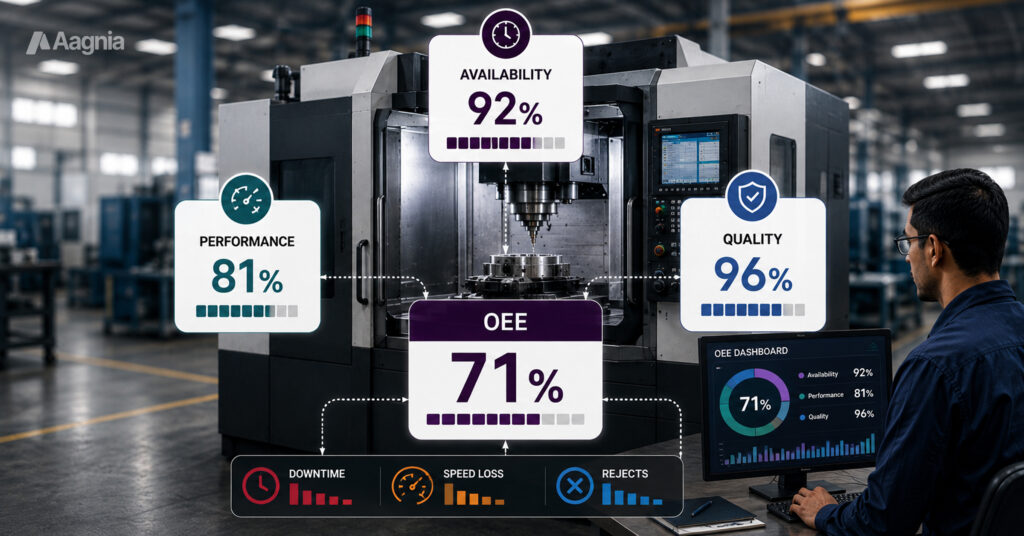
OEE = Availability × Performance × Quality

Availability

Availability measures how much of the planned production time the equipment was actually available for production.

It considers losses such as:

• Equipment breakdowns
• Unplanned downtime
• Changeovers
• Setup time
• Maintenance-related stoppages
• Other production interruptions

A machine may be scheduled to run for eight hours, but breakdowns and changeovers can reduce the actual production time available.

Performance

Performance measures whether the equipment is operating at its expected production speed.

Performance losses can occur when:

• Machines run slower than the ideal cycle time
• Minor stoppages occur frequently
• Operators need to make repeated adjustments
• Production cycles take longer than expected

A machine may be available for production but still produce less than its expected output because it is operating below its ideal speed.

Quality

Quality measures how much of the production output meets the required quality standards.

Quality losses can include:

• Defective parts
• Rejected products
• Scrap
• Rework
• Production produced during startup or adjustment periods

A production line may achieve its planned output, but if a significant portion requires rework or is rejected, the effective production performance is reduced.

Together, Availability, Performance, and Quality provide a broader view of how effectively manufacturing equipment is being utilized.

Why Does OEE Matter in Manufacturing?

Production teams often have access to large amounts of machine and production data. However, raw data alone does not always make it easy to identify the most important production losses.

OEE helps organize this information into measurable performance indicators.

It can help manufacturers identify:

• Equipment with high production losses
• Recurring downtime causes
• Speed and cycle-time losses
• Underperforming production lines
• Shift-wise performance differences
• Scrap and rejection levels
• Rework-related losses
• Opportunities for continuous improvement

For example, instead of simply reporting 45 minutes of downtime, production teams can investigate whether those 45 minutes were caused by a machine breakdown, material shortage, setup activity, operator intervention, or another stoppage category.This provides greater visibility into the actual source of production loss.

How OEE Helps Reduce Manufacturing Losses

1. Reduce Downtime

Downtime is one of the most visible sources of production loss.

By tracking breakdowns, maintenance activities, changeovers, and other stoppages, manufacturers can identify recurring downtime patterns.

For example, if a particular machine repeatedly stops because of the same issue, historical downtime data can help maintenance and production teams investigate the underlying cause and take corrective action.

2. Improve Machine Performance

A machine may be running continuously but still produce less than expected.

Comparing the ideal production rate with actual production output helps identify performance losses caused by slow cycles, minor stoppages, or reduced operating speeds.

Monitoring cycle time and production rates can therefore help teams understand whether equipment is operating close to its expected capability.

3. Improve Production Quality

Quality losses directly affect effective production output.

Tracking good production, rejected parts, scrap, and rework helps manufacturers understand how quality issues are affecting overall equipment effectiveness.

When quality losses are connected with production and machine data, teams can investigate whether particular machines, products, processes, or shifts are associated with higher rejection rates.

4. Improve Equipment Utilization

OEE can also be used to compare equipment and production performance across different operating conditions.

Manufacturers can analyze performance across:

• Machines
• Production lines
• Products
• Shifts
• Production orders
• Time periods

These comparisons can help identify areas where equipment utilization or production performance differs significantly.

OEE and Real-Time Manufacturing Data

Traditional production reporting often depends on data collected and reviewed after production has taken place.

While end-of-shift or end-of-day reports are useful, they may not provide enough visibility to respond to production losses while they are happening.

This is where Industrial IoT (IIoT), machine monitoring, and real-time production data can complement OEE.

Connected machines and production systems can provide information about:

• Machine operating status
• Production counts
• Cycle times
• Downtime
• Production orders
• Rejected quantities
• Machine alarms
• Availability
• Performance
• Quality

When this information is available through real-time dashboards, production teams can monitor equipment performance while production is running rather than waiting for a later report.

From OEE Measurement to Continuous Improvement

OEE becomes more valuable when it is used as part of a continuous improvement process rather than treated as just a percentage on a dashboard.

A practical improvement cycle can be represented as:

Measure → Identify Loss → Understand the Cause → Take Action → Improve

For example, if a production line shows reduced OEE, the next step is not simply to focus on improving the percentage.

Teams can investigate:

  1. What caused the reduction?
  2. Was the loss related to availability, performance, or quality?
  3. Which machine or process contributed to the loss?
  4. How frequently is the issue occurring?
  5. What corrective action can be taken?
  6. Did the action improve the subsequent production performance?

This approach helps transform OEE from a reporting metric into a tool for continuous improvement.

The Role of Real-Time OEE Dashboards

A real-time OEE dashboard can bring different production indicators together in a single view.

Depending on the manufacturing environment, a dashboard may display:

  • Current OEE
  • Availability
  • Performance
  • Quality
  • Production target vs. actual
  • Machine status
  • Downtime duration
  • Downtime categories
  • Production quantity
  • Rejection quantity
  • Cycle time
  • Shift-wise performance

With this information available in one place, production and management teams can gain a clearer understanding of what is happening on the shop floor.

OEE Is More Than a Percentage

OEE is often viewed as a single percentage, but its real value comes from understanding the losses behind that number.

A reduction in OEE could be caused by completely different problems:

  • Frequent machine breakdowns
  • Longer-than-expected cycle times
  • Excessive changeover time
  • Minor stoppages
  • Material availability issues
  • Increased rejection
  • Rework
  • Process-related losses

Therefore, improving OEE requires more than simply trying to increase the final percentage. Manufacturers need visibility into the individual losses contributing to the result.

Conclusion:

OEE provides manufacturers with a structured way to understand how effectively equipment is being used during planned production time.

By combining Availability, Performance, and Quality, OEE helps identify where production efficiency is being lost and provides a basis for investigating the underlying causes.

When OEE is combined with Industrial IoT, machine monitoring, production analytics, and real-time dashboards, manufacturers can move beyond periodic reporting toward continuous visibility of production performance.

The objective is not simply to achieve a higher OEE value.

The objective is to understand production losses, identify their causes, take corrective action, and continuously improve manufacturing performance.


Measure performance. Identify the loss. Understand the cause. Improve production.