Every manufacturing facility generates thousands of data points every day.
But here’s the real question:
Is your data helping you make faster decisions — or simply creating more complexity?
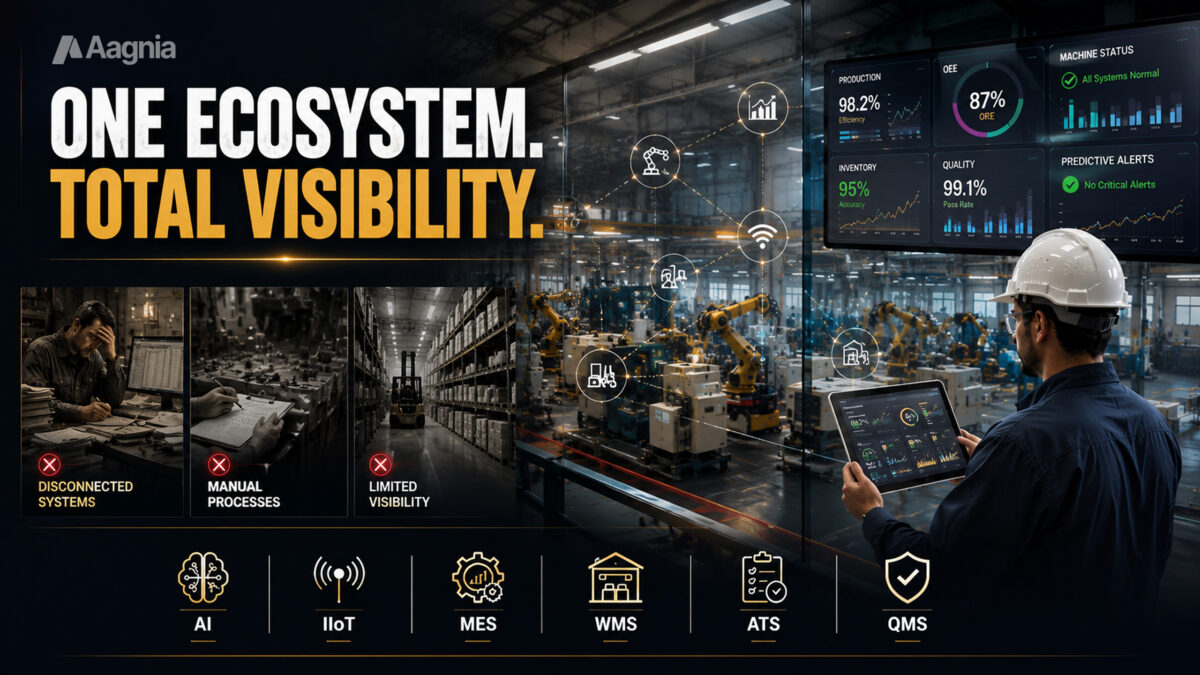
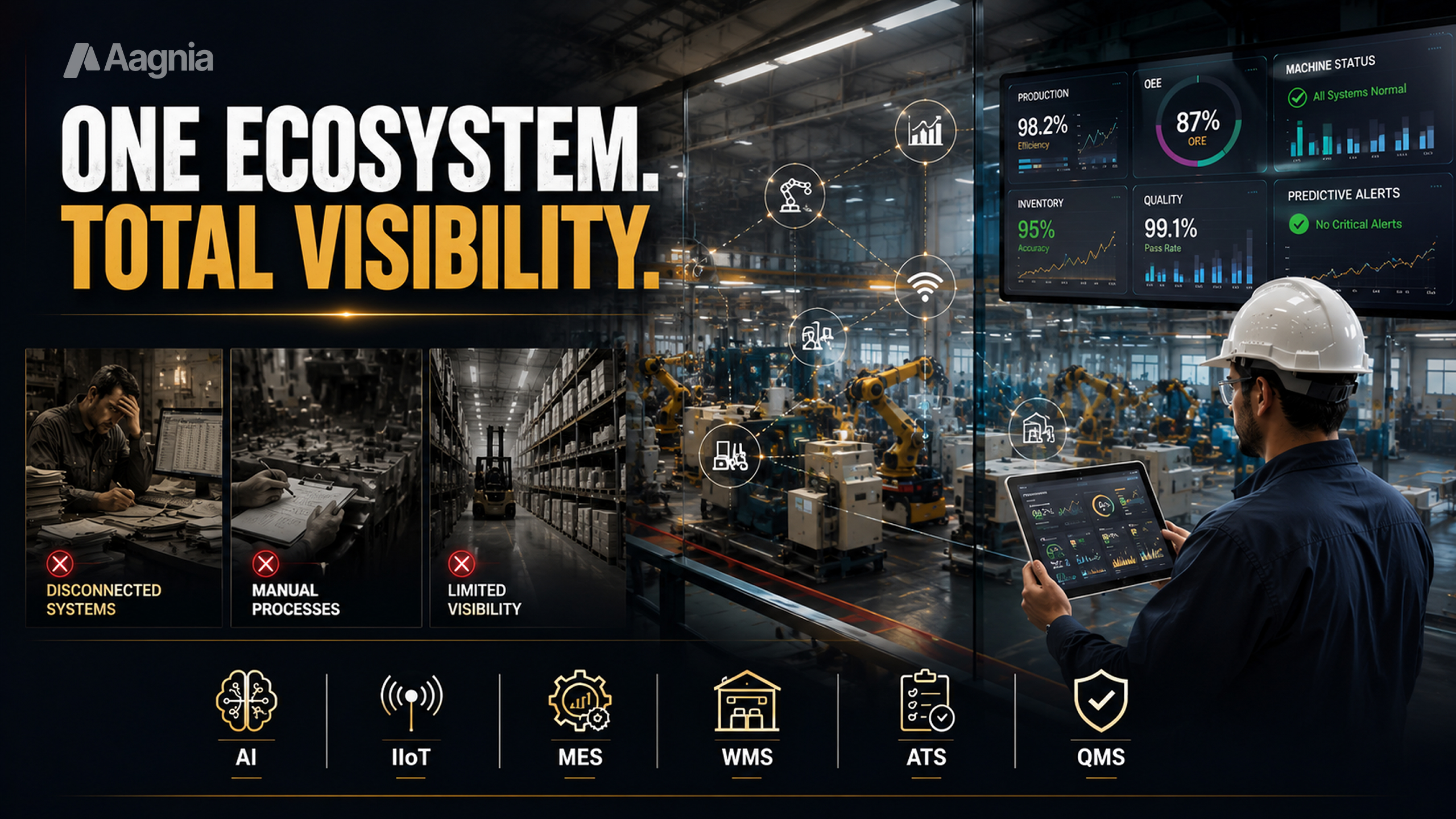
Many manufacturers still rely on disconnected systems, manual reporting, and delayed updates. As a result, critical decisions are often made after production issues have already impacted quality, delivery, or costs.
Does This Sound Familiar?
- Production data is scattered across multiple software applications.
- Machine performance is tracked manually with delayed updates.
- Inventory discrepancies slow down production planning.
- Maintenance begins only after equipment fails.
- Managers spend hours compiling reports instead of improving operations.
These aren’t technology problems – they’re connectivity problems.
When systems operate independently, valuable information remains isolated. Production teams may have one set of data, warehouse teams another, and management may have to wait for reports before getting a complete picture of operations.
Building a Connected Manufacturing Ecosystem
This is where AI, Industrial IoT, Warehouse Management Systems (WMS), and Manufacturing Execution Systems (MES) work together to create a truly connected manufacturing ecosystem.
Each technology addresses a different part of the manufacturing operation:
- AI transforms production data into actionable insights and predicts potential issues.
- Industrial IoT delivers real-time visibility into machines, assets, and operations.
- WMS ensures accurate inventory, material movement, and warehouse efficiency.
- MES connects production planning with shop-floor execution, enabling complete operational control.
- Unified dashboards provide live insights for faster and smarter decision-making.
- Predictive analytics reduce downtime and improve overall equipment effectiveness (OEE).
When these systems are connected, manufacturers can move beyond simply collecting data and start using it to understand what is happening across the factory.
Digital Transformation Doesn’t Have to Happen Overnight
The best part?
You don’t need to digitize your entire factory overnight.
Many successful manufacturers start with one production line, one warehouse, or a few critical machines. They measure the results, identify areas for improvement, and gradually expand the solution without disrupting daily operations.
This approach allows manufacturers to introduce new technologies while continuing their existing production activities.
Imagine the Difference
A connected manufacturing environment can provide:
- Real-time visibility across production and warehouse operations
- Reduced machine downtime through predictive maintenance
- Improved inventory accuracy and material traceability
- Faster production planning and execution
- Better product quality with AI-driven insights
- Lower operational costs and higher overall efficiency
The value isn’t simply in having more software or collecting more data.
It comes from connecting the right systems and making that information available to the people who need it.
From Delayed Reports to Real-Time Decisions
Traditional manufacturing operations often depend on reports that are generated after an activity has already taken place.
By the time a problem appears in a report, the opportunity to prevent it may have already passed.
With connected systems, teams can access operational information closer to real time. Production performance, machine conditions, inventory movement, and other critical information can be brought together to support faster decisions.
This helps shift manufacturing operations from:
Manual updates → Connected data
Delayed reports → Real-time visibility
Reactive maintenance → Predictive maintenance
Disconnected systems → One connected ecosystem
Empowering People With Better Information
The future of manufacturing isn’t about replacing people — it’s about empowering them with the right information at the right time.
Operators can gain better visibility into machines and production. Warehouse teams can work with more accurate inventory information. Maintenance teams can identify potential issues earlier. Managers can make decisions using current operational data instead of waiting for multiple reports.
When people, machines, and systems are connected, technology becomes a tool for improving everyday manufacturing decisions.
Conclusion:
Smart manufacturing is not about adopting every technology at once.
It’s about connecting the systems that matter, making operational data accessible, and using that information to improve the way people work.
By bringing together AI, Industrial IoT, WMS, MES, and real-time reporting, manufacturers can build a more connected operation with greater visibility, faster decision-making, and better control across the factory.
If you could eliminate one manufacturing challenge today, what would it be — machine downtime, inventory visibility, production planning, quality control, or shop-floor connectivity?
- Smart Factories: WMS, MES, AI & Real-Time Data
- Industrial IoT for Foundries: Smarter, Connected Manufacturing
- RFID Asset Tracking for Manufacturing: Reduce Audit Time
- How OEE Helps Manufacturing Improve Production Efficiency
- Real-Time Machine Monitoring: Turning Manufacturing Data into Actionable Insights
- Revolutionizing Parking Management A Real-Time Example
- The Importance of Regular Application Maintenance
- Logistics Software Solutions and Software Development
- Software Development Services for SMEs
- How Does IoT Aid Businesses in a Variety of Industries