How MES, IoT, WMS & AI Work Together in a Smart Factory
A smart factory is more than a collection of connected machines. It is an integrated manufacturing environment where machines, production systems, warehouse operations, and data analytics work together to improve operational efficiency and support better decision-making.
In many manufacturing facilities, these functions operate independently. Production teams manage work orders and output, maintenance teams monitor machine performance, warehouse teams track inventory, and management relies on reports to understand overall performance. When these systems do not share information effectively, it becomes difficult to identify the root causes of delays, coordinate resources, and respond quickly to changing production requirements.
For example, a production line may stop because a machine develops a fault or a required material is unavailable. If machine monitoring, production tracking, and inventory management operate separately, teams may need to investigate different systems before understanding the problem. This can delay corrective action and affect production schedules.
Integrating the Industrial Internet of Things (IoT), Manufacturing Execution System (MES), Warehouse Management System (WMS), and Artificial Intelligence (AI) helps address these information gaps. Each technology serves a distinct purpose, but together they create a more connected view of manufacturing operations.
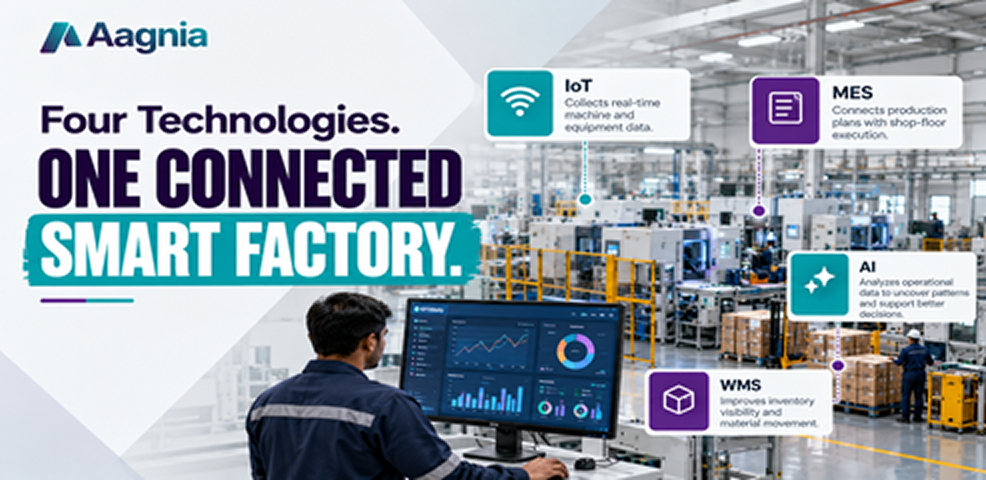
IoT provides real-time equipment data, MES connects production plans with actual execution, WMS manages inventory and material movement, and AI analyzes operational data to identify patterns and support informed decisions.
The objective is not simply to introduce more technology. It is to connect operational information so manufacturers can understand what is happening, identify what needs attention, and take appropriate action.
IoT: Real-Time Machine Monitoring :
Industrial IoT forms the data collection layer of a connected factory. It connects machines, sensors, controllers, and other industrial equipment to capture operational information that helps manufacturers understand equipment conditions and shop-floor activity.
Depending on the equipment and integration, IoT solutions can collect information such as machine operating status, temperature, pressure, vibration, energy consumption, cycle time, and downtime events. This data provides a more current picture of equipment performance than periodic manual updates alone.
How IoT Improves Manufacturing Visibility :
In a traditional manufacturing environment, operators may record machine readings manually or report equipment stoppages after they occur. This can create gaps between the actual shop-floor situation and the information available to supervisors.
IoT-enabled monitoring helps reduce these gaps by collecting equipment data at defined intervals or in real time, depending on the system configuration. Teams can use dashboards and alerts to monitor operating conditions, recognize unexpected changes, and investigate machine interruptions sooner.
For example, if a machine repeatedly stops during a production shift, its operating data can help maintenance and production teams understand when the stoppages occurred and whether they were associated with particular operating conditions.
How IoT Works with Other Systems :
IoT data becomes more useful when it is connected to production and business context. Integrated with MES, machine events can be associated with production orders, output, and shift information. This helps teams understand how equipment performance affects production targets.
When machine data is also available for AI analysis, manufacturers can investigate recurring patterns, identify anomalies, and explore opportunities for predictive maintenance.
Key benefit: IoT improves machine-level visibility and provides operational data that other manufacturing systems can use for analysis and decision-making.
MES: Connecting Production Planning with Shop-Floor Execution :
A Manufacturing Execution System (MES) connects production planning with the activities taking place on the shop floor. It helps manufacturers track production orders, monitor progress, record output, manage work-in-progress, and maintain visibility into manufacturing processes.
While planning systems define what needs to be produced, MES helps teams understand how production is progressing and whether actual execution is aligned with the plan.
How MES Supports Production Operations :
Manufacturing involves multiple connected activities, including work order release, material consumption, machine operation, quality checks, and production reporting. Without a consistent system for tracking these activities, supervisors may struggle to obtain accurate information about current production status.
MES provides a structured way to record and monitor these operations. Depending on its capabilities, it can help teams track production quantities, identify delays, record process parameters, monitor quality results, and maintain production history.
For example, if a work order requires 1,000 components, MES can help track completed quantities, rejected units, and work remaining. Supervisors can use this information to compare actual progress with planned production and investigate deviations.
How MES Works with IoT, WMS, and AI :
When integrated with IoT, MES can use machine events and operating data to provide better visibility into production performance. Teams can compare machine availability, cycle times, and downtime with actual output.
Integration with WMS helps align material availability with production requirements. This can make it easier to identify whether a production delay is related to equipment performance, material shortages, or another operational issue.
AI can analyze production history and machine data to identify recurring bottlenecks, variations in output, or patterns associated with quality problems.
Key benefit: MES provides the production context needed to connect machine activity, work orders, output, and process performance.
WMS: Improving Inventory Visibility and Material Flow :
A Warehouse Management System (WMS) manages inventory and warehouse activities, including stock locations, goods receipt, put-away, picking, material transfers, and dispatch. It helps manufacturers understand what materials are available, where they are stored, and how they move through the warehouse.
In manufacturing, inventory management is closely connected to production performance. Even when machines and production schedules are ready, missing raw materials, misplaced components, or inaccurate stock records can delay operations.
How WMS Supports Manufacturing :
A WMS helps warehouse teams maintain structured inventory records and track material movements. Depending on the solution, barcode scanning, mobile transactions, and other identification technologies can improve the accuracy of warehouse operations.
Better inventory visibility helps teams check stock availability, locate required materials, and track movements between storage areas and production locations. It can also support more reliable material consumption records and finished-goods handling.
For example, if a production order requires specific raw materials, warehouse personnel can use inventory information to check availability and prepare the required materials for the scheduled operation.
Connecting WMS with MES and IoT :
When WMS and MES exchange information, warehouse activities can be coordinated with production requirements. Material reservations, picking activities, and consumption records can help production teams understand whether the necessary materials are ready for use.
IoT and connected identification technologies may provide additional visibility into equipment, storage conditions, or material movement where suitable sensors and integrations are available.
AI can also analyze inventory and production data to help identify recurring shortages, changing consumption patterns, and opportunities to improve replenishment planning.
Key benefit: WMS strengthens inventory accuracy and material coordination, helping reduce avoidable delays caused by poor stock visibility or inefficient warehouse processes.
AI: Turning Manufacturing Data into Actionable Insights :
Manufacturing systems generate large amounts of data. IoT captures equipment information, MES records production activities, and WMS maintains inventory and material movement records. However, collecting data alone does not automatically explain why problems occur or what action should be taken.
Artificial Intelligence (AI) can help analyze these datasets to identify patterns, highlight anomalies, and support operational decisions. Its effectiveness depends on data quality, system integration, suitable models, and validation against actual manufacturing conditions.
Practical Applications of AI in Manufacturing :
Predictive maintenance: AI models can analyze historical equipment data and relevant operating parameters to identify patterns associated with potential equipment problems. This can help maintenance teams prioritize inspections and plan interventions when the available data supports reliable predictions.
Production optimization: By analyzing production history, cycle times, downtime, and throughput, AI can help identify recurring bottlenecks and opportunities to improve resource utilization.
Quality analysis: AI can examine process parameters and quality records to identify conditions associated with defects or process variations, helping teams focus their investigations.
Inventory forecasting: By analyzing material consumption, production schedules, and historical demand, AI can support inventory planning and replenishment decisions.
Why Connected Data Matters for AI :
AI insights become more valuable when the data includes operational context. A machine stoppage, for instance, is only one part of a larger production event. Understanding the affected work order, production shift, material availability, and process history can help teams investigate the issue more effectively.
By connecting relevant information from IoT, MES, and WMS, manufacturers can provide AI tools with a broader view of operational conditions. The resulting insights can help teams prioritize investigations and evaluate improvement opportunities.
AI does not replace experienced operators, engineers, or supervisors. Instead, it can support their decisions by making complex operational patterns easier to identify and assess.
Key benefit: AI helps transform connected manufacturing data into insights that support maintenance, production, quality, and inventory decisions.
Conclusion : Building a Smarter, Connected Factory
A smart factory is not defined by the number of machines connected or the volume of data collected. Its real value comes from how effectively that information supports daily manufacturing operations.
IoT provides visibility into machine performance. MES connects production plans with shop-floor execution. WMS improves inventory accuracy and material coordination. AI analyzes operational data to identify patterns and support better decisions.
When these technologies are integrated effectively, manufacturers can build a more complete view of their operations, investigate disruptions with greater context, coordinate production and material requirements, and identify opportunities for continuous improvement.
The journey toward a connected factory starts with understanding existing processes, identifying information gaps, and integrating systems around clear operational goals. Reliable data, suitable infrastructure, and well-defined workflows are essential to achieving meaningful results.
Contact us today to book a demo and discover how IoT3Sixty can help connect your manufacturing operations and turn shop-floor data into actionable insights.