
How OEE Helps Manufacturing Improve Production Efficiency
A machine can be running and still not be producing at its full potential.
Production losses can occur through machine breakdowns, slow cycles, changeovers, minor stoppages, material delays, quality defects, and rework. While these losses may appear small individually, their cumulative impact can significantly affect production efficiency.
For manufacturers, the challenge is not simply knowing that production output is lower than expected. The real challenge is understanding where the loss is occurring, why it is happening, and how it can be reduced.
This is where Overall Equipment Effectiveness (OEE) becomes an important manufacturing performance metric.
What Is OEE?
Overall Equipment Effectiveness (OEE) is a key performance indicator used to measure how effectively equipment is being utilized during planned production time.
OEE combines three important factors:
OEE = Availability × Performance × Quality
Availability
Availability measures how much of the planned production time the equipment was actually available for production.
It considers losses such as:
• Equipment breakdowns
• Unplanned downtime
• Changeovers
• Setup time
• Maintenance-related stoppages
• Other production interruptions
A machine may be scheduled to run for eight hours, but breakdowns and changeovers can reduce the actual production time available.
Performance
Performance measures whether the equipment is operating at its expected production speed.
Performance losses can occur when:
• Machines run slower than the ideal cycle time
• Minor stoppages occur frequently
• Operators need to make repeated adjustments
• Production cycles take longer than expected
A machine may be available for production but still produce less than its expected output because it is operating below its ideal speed.
Quality
Quality measures how much of the production output meets the required quality standards.
Quality losses can include:
• Defective parts
• Rejected products
• Scrap
• Rework
• Production produced during startup or adjustment periods
A production line may achieve its planned output, but if a significant portion requires rework or is rejected, the effective production performance is reduced.
Together, Availability, Performance, and Quality provide a broader view of how effectively manufacturing equipment is being utilized.
Why Does OEE Matter in Manufacturing?
Production teams often have access to large amounts of machine and production data. However, raw data alone does not always make it easy to identify the most important production losses.
OEE helps organize this information into measurable performance indicators.
It can help manufacturers identify:
• Equipment with high production losses
• Recurring downtime causes
• Speed and cycle-time losses
• Underperforming production lines
• Shift-wise performance differences
• Scrap and rejection levels
• Rework-related losses
• Opportunities for continuous improvement
For example, instead of simply reporting 45 minutes of downtime, production teams can investigate whether those 45 minutes were caused by a machine breakdown, material shortage, setup activity, operator intervention, or another stoppage category.This provides greater visibility into the actual source of production loss.
How OEE Helps Reduce Manufacturing Losses
1. Reduce Downtime
Downtime is one of the most visible sources of production loss.
By tracking breakdowns, maintenance activities, changeovers, and other stoppages, manufacturers can identify recurring downtime patterns.
For example, if a particular machine repeatedly stops because of the same issue, historical downtime data can help maintenance and production teams investigate the underlying cause and take corrective action.
2. Improve Machine Performance
A machine may be running continuously but still produce less than expected.
Comparing the ideal production rate with actual production output helps identify performance losses caused by slow cycles, minor stoppages, or reduced operating speeds.
Monitoring cycle time and production rates can therefore help teams understand whether equipment is operating close to its expected capability.
3. Improve Production Quality
Quality losses directly affect effective production output.
Tracking good production, rejected parts, scrap, and rework helps manufacturers understand how quality issues are affecting overall equipment effectiveness.
When quality losses are connected with production and machine data, teams can investigate whether particular machines, products, processes, or shifts are associated with higher rejection rates.
4. Improve Equipment Utilization
OEE can also be used to compare equipment and production performance across different operating conditions.
Manufacturers can analyze performance across:
• Machines
• Production lines
• Products
• Shifts
• Production orders
• Time periods
These comparisons can help identify areas where equipment utilization or production performance differs significantly.
OEE and Real-Time Manufacturing Data
Traditional production reporting often depends on data collected and reviewed after production has taken place.
While end-of-shift or end-of-day reports are useful, they may not provide enough visibility to respond to production losses while they are happening.
This is where Industrial IoT (IIoT), machine monitoring, and real-time production data can complement OEE.
Connected machines and production systems can provide information about:
• Machine operating status
• Production counts
• Cycle times
• Downtime
• Production orders
• Rejected quantities
• Machine alarms
• Availability
• Performance
• Quality
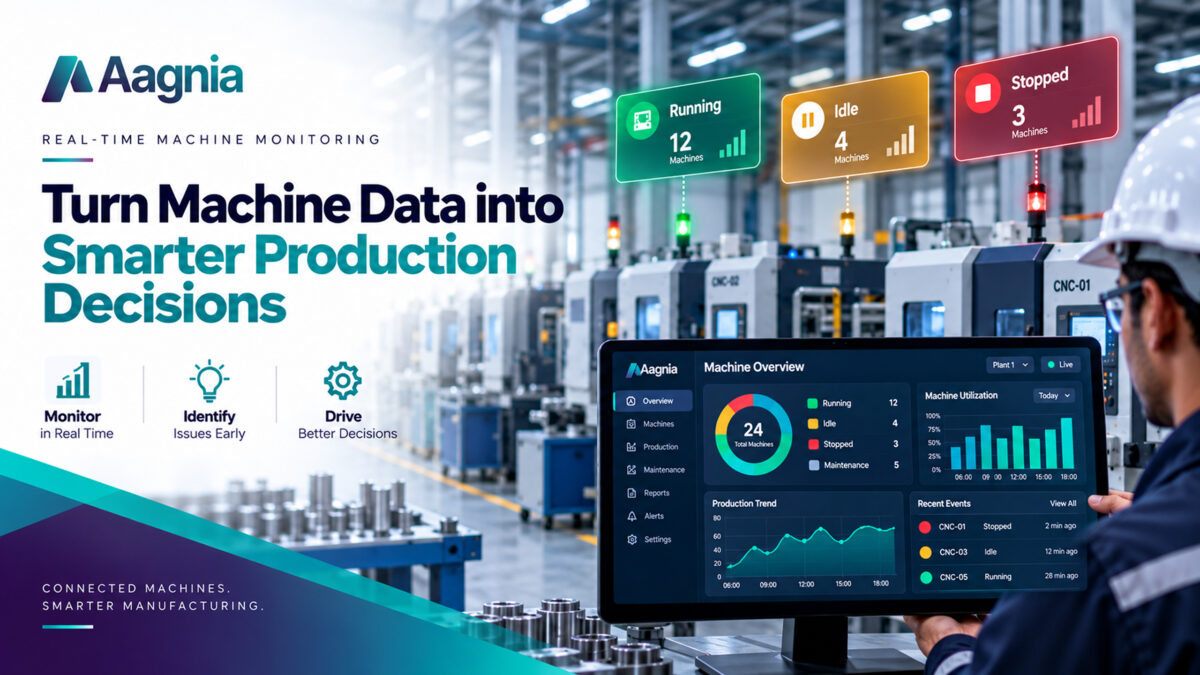
When this information is available through real-time dashboards, production teams can monitor equipment performance while production is running rather than waiting for a later report.
From OEE Measurement to Continuous Improvement
OEE becomes more valuable when it is used as part of a continuous improvement process rather than treated as just a percentage on a dashboard.
A practical improvement cycle can be represented as:
Measure → Identify Loss → Understand the Cause → Take Action → Improve
For example, if a production line shows reduced OEE, the next step is not simply to focus on improving the percentage.
Teams can investigate:
- What caused the reduction?
- Was the loss related to availability, performance, or quality?
- Which machine or process contributed to the loss?
- How frequently is the issue occurring?
- What corrective action can be taken?
- Did the action improve the subsequent production performance?
This approach helps transform OEE from a reporting metric into a tool for continuous improvement.
The Role of Real-Time OEE Dashboards
A real-time OEE dashboard can bring different production indicators together in a single view.
Depending on the manufacturing environment, a dashboard may display:
- Current OEE
- Availability
- Performance
- Quality
- Production target vs. actual
- Machine status
- Downtime duration
- Downtime categories
- Production quantity
- Rejection quantity
- Cycle time
- Shift-wise performance
With this information available in one place, production and management teams can gain a clearer understanding of what is happening on the shop floor.
OEE Is More Than a Percentage
OEE is often viewed as a single percentage, but its real value comes from understanding the losses behind that number.
A reduction in OEE could be caused by completely different problems:
- Frequent machine breakdowns
- Longer-than-expected cycle times
- Excessive changeover time
- Minor stoppages
- Material availability issues
- Increased rejection
- Rework
- Process-related losses
Therefore, improving OEE requires more than simply trying to increase the final percentage. Manufacturers need visibility into the individual losses contributing to the result.
Conclusion:
OEE provides manufacturers with a structured way to understand how effectively equipment is being used during planned production time.
By combining Availability, Performance, and Quality, OEE helps identify where production efficiency is being lost and provides a basis for investigating the underlying causes.
When OEE is combined with Industrial IoT, machine monitoring, production analytics, and real-time dashboards, manufacturers can move beyond periodic reporting toward continuous visibility of production performance.
The objective is not simply to achieve a higher OEE value.
The objective is to understand production losses, identify their causes, take corrective action, and continuously improve manufacturing performance.
Measure performance. Identify the loss. Understand the cause. Improve production.
- MQTT in Modern Manufacturing
- How Smart Batch Operations Improve Production Traceability
- Predictive Maintenance: How IoT and AI Work Together
- IOT3Sixty MES for Downtime Tracking and Analysis
- Production Planning and Shop Floor Execution
- Manufacturing Execution System (MES): Smart Factory Solution
- Warehouse Management System (WMS) for Smarter Warehouses
- Smart Factories: WMS, MES, AI & Real-Time Data
- Industrial IoT for Foundries: Smarter, Connected Manufacturing
- RFID Asset Tracking for Manufacturing: Reduce Audit Time