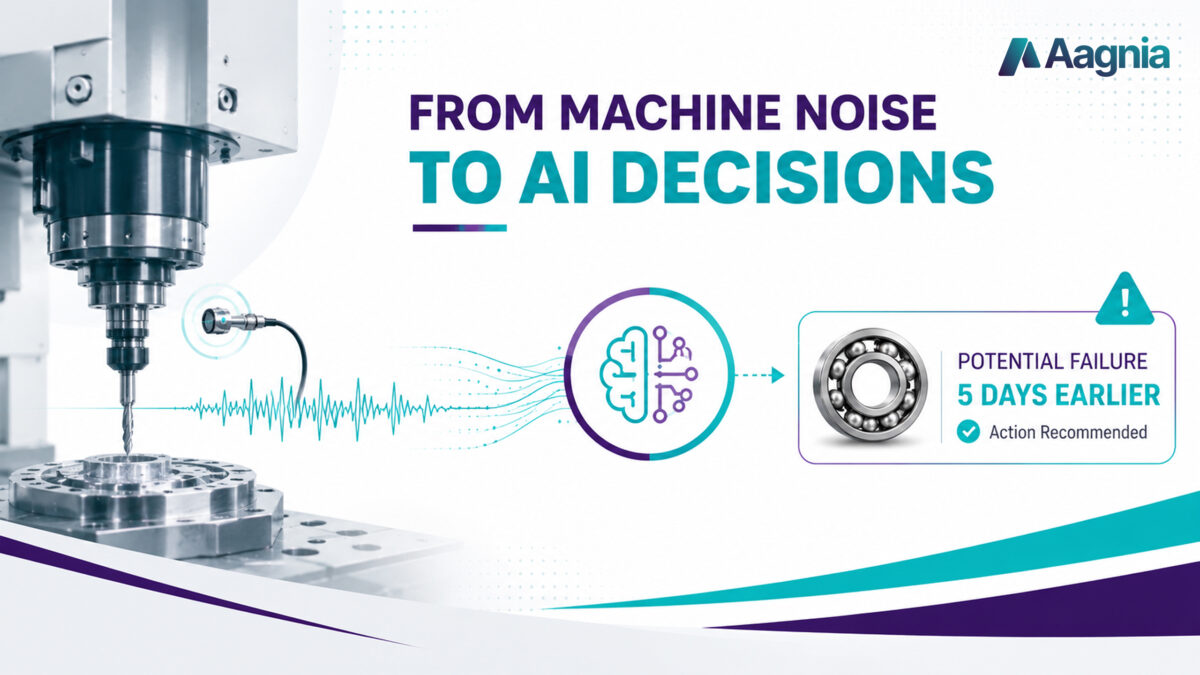
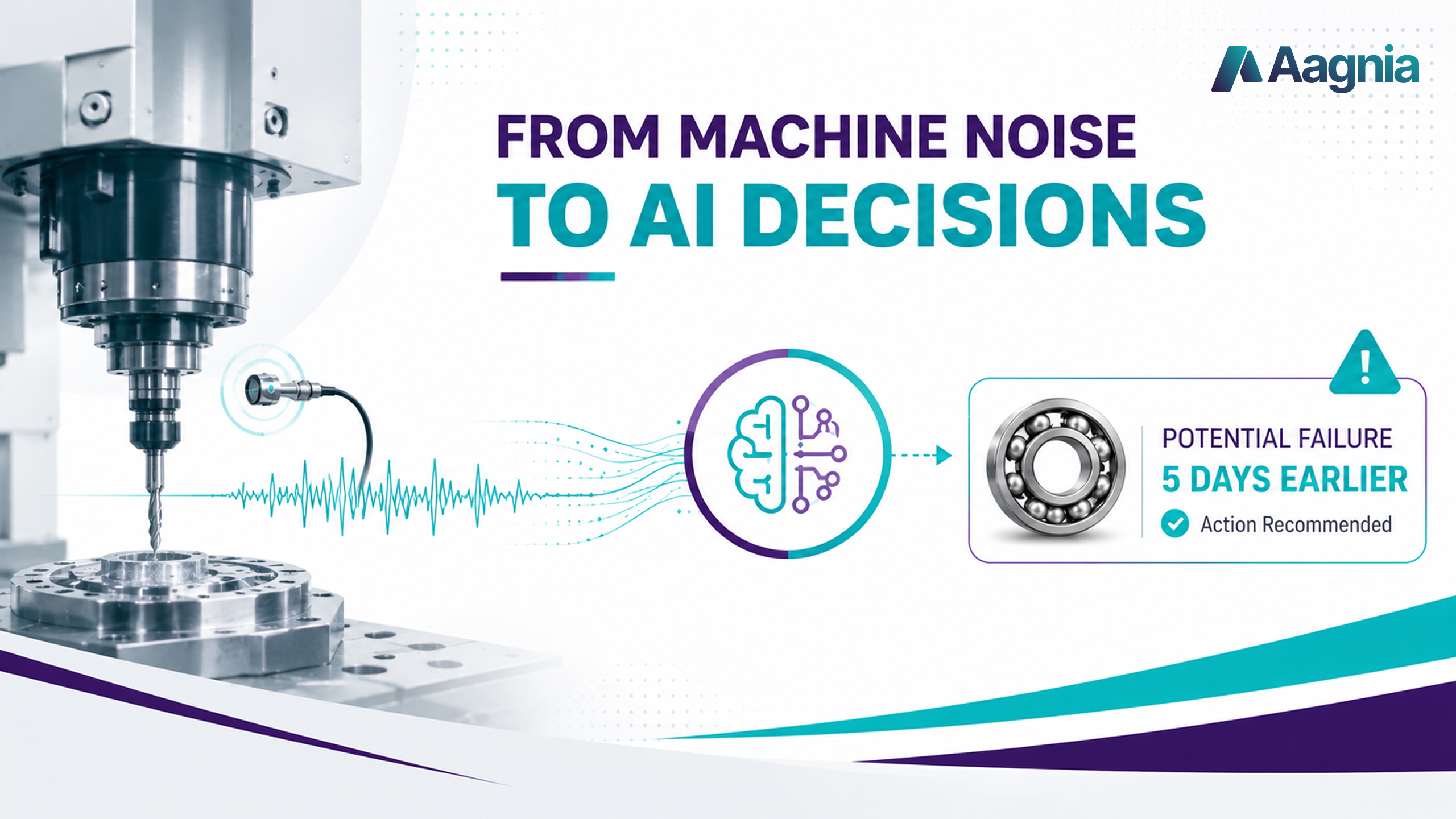
From Machine Noise to AI Decisions
What if your factory could detect equipment degradation before it causes an unexpected breakdown?
Predictive maintenance combines Industrial IoT, machine data, analytics, and AI to identify changing equipment conditions and support proactive maintenance decisions.
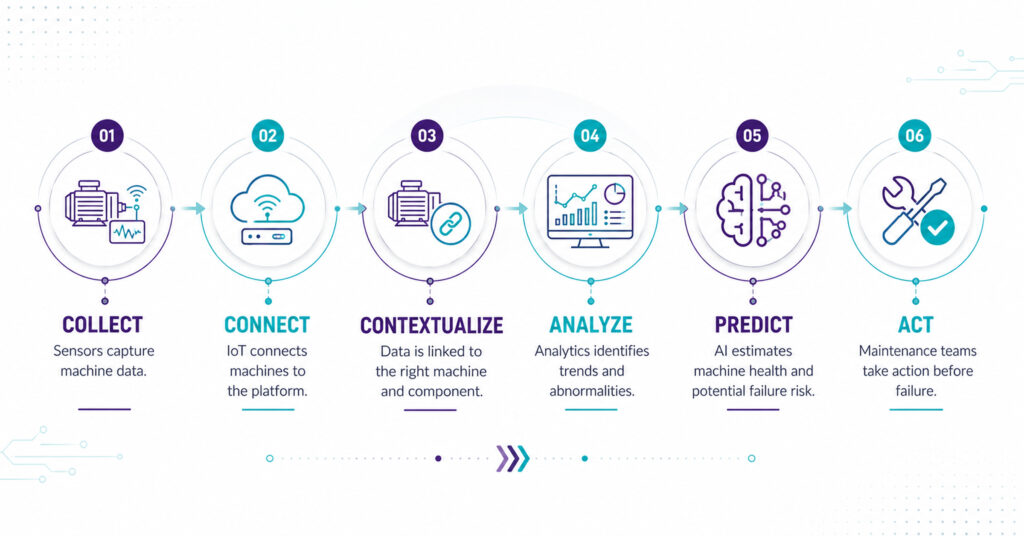
The journey can be summarized as:
Collect → Connect → Contextualize → Analyze → Predict → Act
What Happens When a Critical Machine Fails?
A CNC machine suddenly stops during production.
The spindle bearing has failed.
Production stops. Operators wait. Maintenance responds urgently. Spare parts may need to be sourced, and delivery schedules can be affected.
But what if the machine had already been showing warning signs?
Predictive maintenance helps manufacturers identify those signals early, giving maintenance teams more time to investigate, plan, and respond.
Meet CNC-001
Machine: CNC-001
Operation: Rotor Turning
Critical Component: Spindle Bearing
Spindle Speed: 3,500 RPM
The spindle bearing is critical to smooth and reliable machine operation.
Sensors continuously monitor parameters such as:
- Vibration
- Temperature
- Motor current
- Spindle speed
- Machine status
Think of sensors as a smartwatch for the machine—continuously capturing its condition.
Step 1: Collect -The Machine Starts Talking
Sensors generate real-time machine data.
For example:
Vibration: 2.31 mm/s
Temperature: 58°C
A single reading tells us very little.
But collecting these measurements continuously creates a history of how the machine behaves over time.
The journey begins:
Machine → Sensors → Raw Data
The more consistently machine signals are captured, the better the foundation for monitoring and analysis.
Step 2: Connect – IoT Bridges the Factory Floor
Machine data needs to move from industrial equipment into an IoT platform.
An Edge IoT Gateway acts as the connection layer between machines and software.
The architecture is:
Machine & Sensors
↓
Edge IoT Gateway
↓
IOT3Sixty Platform
The gateway helps collect, transfer, and process industrial machine information so it can be used by applications and analytics.
Step 3: Contextualize – Give Data Meaning
A value such as 58 means very little by itself.
But when the system knows:
- Plant: Plant 1
- Line: Rotor Line
- Machine: CNC-001
- Component: Spindle Bearing
- Parameter: Temperature
- Value: 58°C
- Timestamp: 10:32 AM
the number becomes meaningful.
Context turns data into information.
IOT3Sixty connects machine measurements with their operational context so teams can understand what happened, where, when, and to which asset.
Step 4: Analyze – AI Finds the Pattern
Traditional monitoring often asks:
“Did the value cross a threshold?”
Predictive analytics asks a bigger question:
“Is the machine’s behavior changing?”
AI can analyze:
- Historical sensor data
- Operating conditions
- Running hours
- Maintenance history
- Previous failure patterns
For CNC-001, gradually increasing vibration and temperature together may reveal a developing equipment condition.
Threshold Monitoring
Value crosses limit → Alert
Predictive Analytics
Pattern changes → Investigate potential degradation
The difference is important. Traditional threshold monitoring focuses on whether a predefined limit has been crossed, while predictive analytics looks for changes and patterns in equipment behavior.
Step 5: Predict -Look Beyond the Current Condition
Once patterns are identified, predictive maintenance can provide equipment-health indicators such as:
Health Score
64%
Indicates the current level of equipment concern based on the available analysis.
Risk Level
Indicates the current level of equipment risk or concern.
Failure Probability
Estimates the likelihood of a potential failure condition.
Remaining Useful Life
Estimated RUL: 120 hours
RUL is an estimate, not an exact countdown.
Its purpose is to help maintenance teams understand potential equipment life and make better planning decisions.
Step 6: Act – Turn Prediction Into Maintenance
Prediction alone does not prevent downtime.
The insight needs to become an action.
The maintenance decision may consider:
- Production schedules
- Planned shutdowns
- Spare parts
- Technician availability
- Maintenance windows
For CNC-001, the recommendation could be:
“Replace the spindle bearing during Wednesday’s planned shutdown.”
Instead of waiting for an unexpected failure, the team can prepare and act during a planned maintenance window.
AI Insight → Maintenance Action → Reduced Unplanned Downtime
The Complete Predictive Maintenance Journey
The complete journey moves from machine data to maintenance action:
Why Predictive Maintenance Matters
When machine condition becomes visible and actionable, manufacturers can improve several areas of their operations.
Equipment Reliability
Identify developing equipment issues earlier and understand changing machine conditions.
Maintenance Planning
Schedule maintenance around production requirements and planned shutdowns.
Spare-Part Planning
Prepare required parts before emergency repairs are needed.
Production Continuity
Reduce disruption caused by unexpected equipment failures.
Maintenance Costs
Reduce the operational impact of emergency interventions and unplanned maintenance.
Delivery Reliability
Keep production schedules more predictable by reducing unexpected equipment-related disruptions.
Predictive maintenance is ultimately about turning equipment data into better operational decisions.
Compliance and Regulatory Requirements:
In today’s regulatory landscape, businesses must comply with various data protection and privacy regulations. Regular application maintenance plays a critical role in meeting these compliance requirements. By conducting security audits, implementing necessary controls, and ensuring data integrity, businesses can demonstrate their commitment to protecting user information and avoid legal consequences.
Conclusion:
Predictive maintenance gives manufacturers a way to move beyond simply reacting to equipment failures.
By continuously collecting machine data, connecting equipment through Industrial IoT, adding operational context, analyzing patterns, and turning insights into planned maintenance actions, manufacturers can gain a clearer understanding of equipment condition.
The goal is not to predict every failure with certainty. It is to provide maintenance teams with better information earlier, so they can make more informed maintenance decisions.
Know the condition. Understand the pattern. Act earlier.
Turn Machine Data Into Maintenance Insights
Want to turn machine data into actionable maintenance insights?
Explore how IOT3Sixty can help you build a smarter predictive maintenance strategy.
- MQTT in Modern Manufacturing
- How Smart Batch Operations Improve Production Traceability
- Predictive Maintenance: How IoT and AI Work Together
- IOT3Sixty MES for Downtime Tracking and Analysis
- Production Planning and Shop Floor Execution
- Manufacturing Execution System (MES): Smart Factory Solution
- Warehouse Management System (WMS) for Smarter Warehouses
- Smart Factories: WMS, MES, AI & Real-Time Data
- Industrial IoT for Foundries: Smarter, Connected Manufacturing
- RFID Asset Tracking for Manufacturing: Reduce Audit Time